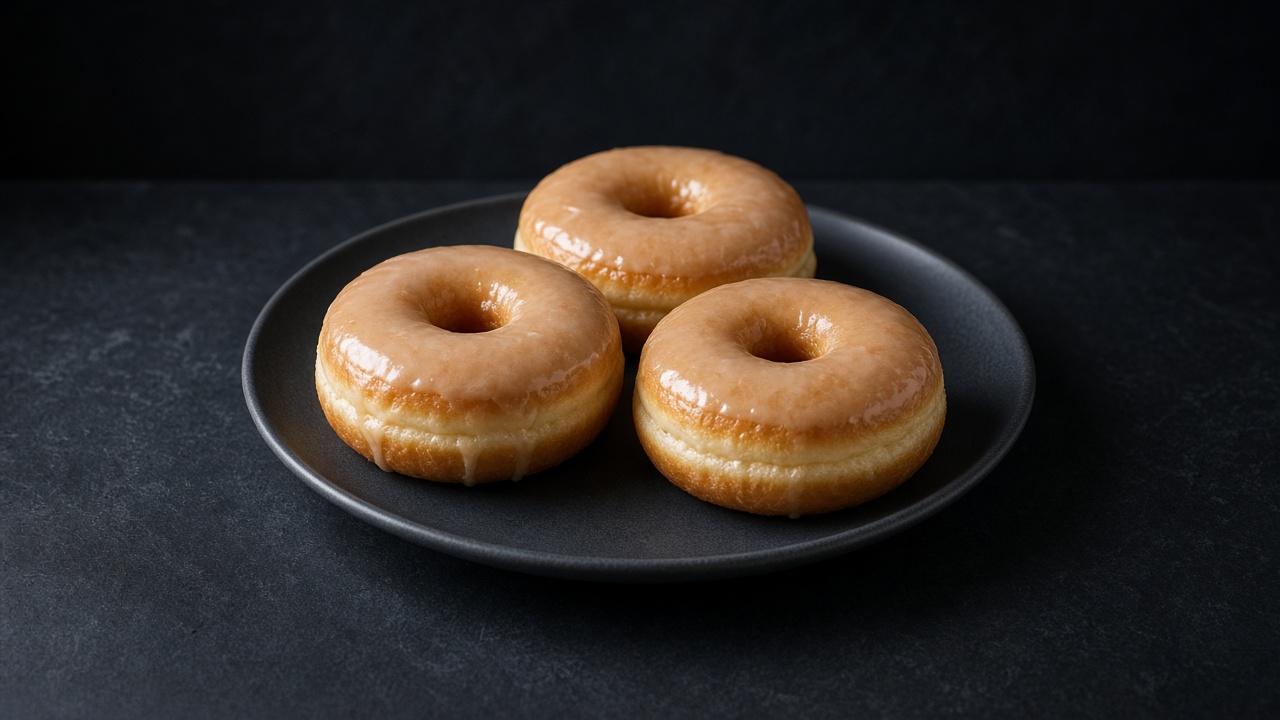
Vanilla-Glazed Yeast-Raised Doughnuts
Inspired by techniques from America's Test Kitchen and King Arthur Baking.
Light, airy yeast-raised ring doughnuts fried to a golden band and dipped in a thin vanilla glaze that sets glossy.
Always check the labels of the products you use.
Method
- 1
Knead the dough. Combine the flour, sugar, yeast, salt and nutmeg, then add the warm milk, egg and vanilla and knead on medium-low (or by hand) for 5 min. Add the soft butter a little at a time and keep kneading 6-8 min more until the dough is smooth, stretchy and just a little tacky. Adding butter after the gluten has formed keeps the doughnuts tender without weakening their structure.
- 2
Let it rise. Cover the bowl and leave it somewhere warm for 1-1.5 h. It should roughly double in size.
- 3
Roll and cut rings. Press the air out and roll the dough 1.2 cm thick on a floured worktop. Stamp out 8 cm rounds and cut a 2.5 cm hole from the middle of each, re-rolling the scraps once to make 12 rings. Lay them on the oiled paper with space between them.
- 4
Prove until puffy. Cover loosely and leave for 30-45 min. When pressed gently with a fingertip, the dough should spring back slowly and leave a slight dent; under-proved rings fry dense, over-proved ones collapse.
- 5
Heat the oil safely. Pour oil into the heavy pan to a depth of about 4 cm, keeping it no more than half full, and heat it to 175 °C on the thermometer. Steady temperature is the key to a dry, golden doughnut rather than a greasy one.
- 6
Fry in small batches. Slide in 3 rings at a time and fry 60-90 seconds on each side, holding the oil between 170 and 180 °C. Lift them out when deep golden with a pale ring round the middle and about 90 °C at the centre, then drain on the rack.
- 7
Glaze while warm. Whisk the icing sugar, hot water and vanilla to a smooth, pourable glaze. Dip the top of each warm doughnut, let the excess run off and leave them on the rack for 10 min. Warmth thins the glaze so it sets in a sheer, crackly layer.
Storage
Best eaten the day they are made. Keep any leftovers loosely covered at room temperature for up to 1 day; freezing is not recommended once glazed.
Equipment
- stand mixer with dough hook (or large bowl)
- 8 cm round cutter and 2.5 cm cutter (or a doughnut cutter)
- rolling pin
- 2 baking trays lined with oiled baking paper
- large heavy pan or casserole, at least 24 cm wide
- deep-frying or probe thermometer
- slotted spoon or spider
- wire rack over a tray lined with kitchen paper
- whisk
Nutrition per serving (estimated values)
| Per serving | Amount |
|---|---|
| Energy | 405 kcal |
| Protein | 5.9 g |
| Carbohydrate | 60 g |
| of which sugars | 27.7 g |
| of which free sugars | 26.3 g |
| Fat | 15.7 g |
| of which saturates | 4 g |
| Fibre | 1.3 g |
| Salt | 0.65 g |
Protein per 100 kcal
1.5 g High Protein needs ≥ 10 g
Calculated from USDA FoodData Central ingredient values