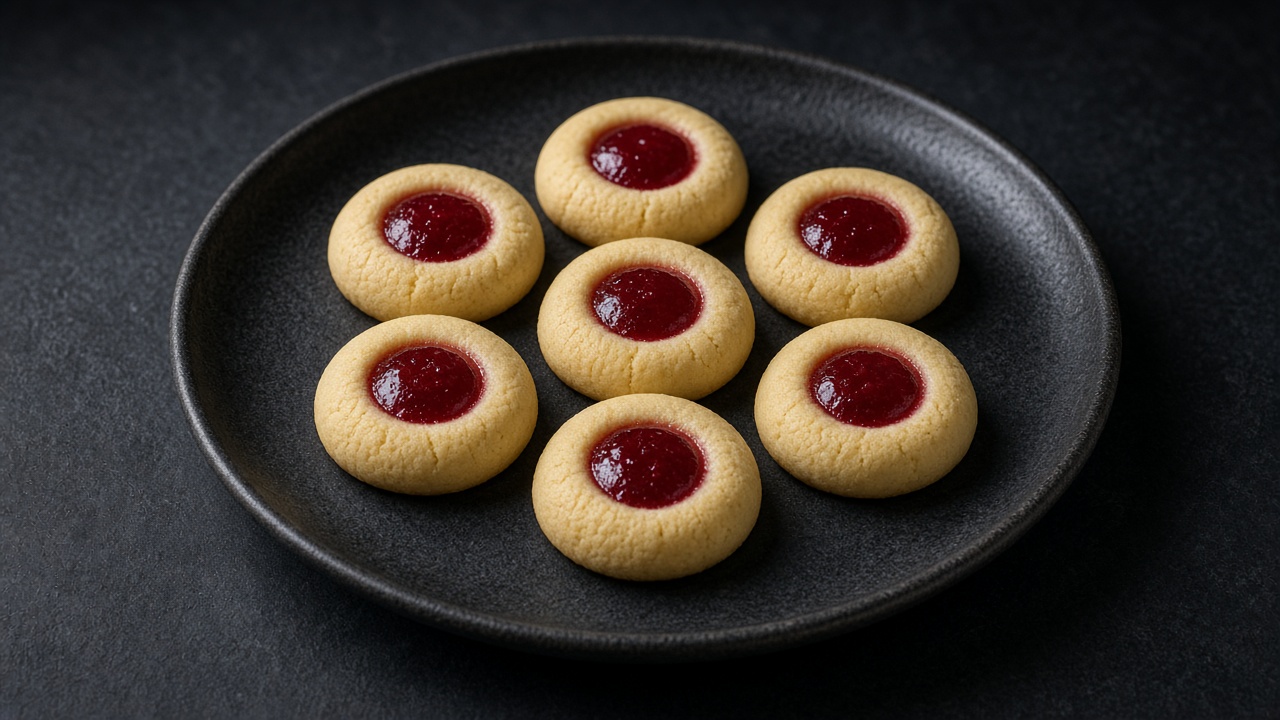
Thumbprint Cookies
Inspired by techniques from King Arthur Baking, America's Test Kitchen and NYT Cooking.
Buttery almond shortbread biscuits with a deep well of lemon curd or jam baked into the centre, finished with golden edges.
Always check the labels of the products you use.
Method
- 1
Cream butter and sugar. Beat the softened butter and caster sugar together on medium speed for 2-3 minutes, until the mixture turns noticeably pale and fluffy. This creaming step beats air into the butter, which keeps the finished biscuit tender rather than dense. Then beat in the egg yolks, vanilla and salt until smooth.
- 2
Mix in almonds and flour. Mix in the ground almonds, then add the flour on low speed and stop the moment the dough comes together. Using only egg yolks, with no whites, keeps the dough low in moisture, which is why it holds its shape — and its well — without spreading in the oven. Overmixing at this stage can develop the flour's gluten and make the biscuits tough.
- 3
Chill the dough. Wrap the dough and chill it for 1 hour. Chilling firms up the butter again, which helps the biscuits keep their shape and that deep thumbprint well once baked. It's also a good point to heat the oven, ready for when the dough comes out of the fridge.
- 4
Heat the oven. While the dough chills, heat the oven to 175°C (155°C fan) for at least 20 minutes, with a shelf in the middle. Giving the oven this much lead time means it's fully up to temperature by the time the dough is ready, so the biscuits set quickly rather than spreading. Line two large metal trays with baking paper if you haven't already.
- 5
Shape and press wells. Roll the dough into 20 g balls, spacing them 4 cm apart on the lined trays, then press a deep well into the centre of each one with the rounded end of a spoon handle. Pinch together any edges that crack as you press, since cracks can open up further in the oven. The well needs to be deep enough to hold the filling without it spilling over the sides.
- 6
First bake. Bake for 10 minutes, until the biscuits are just set but still pale. If the wells have puffed up during baking, press them back down gently with the spoon handle, then spoon the filling into each one. Working quickly here means the filling has time to warm through in the second bake rather than sitting cold.
- 7
Second bake. Return the trays to the oven and bake for a further 6-8 minutes, until the edges of the biscuits turn lightly golden. The filling will look glossy and set at the edges but still soft in the centre at this point, which is normal. Golden edges are the clearest sign these shortbread-style biscuits are properly cooked through.
- 8
Cool carefully. Leave the biscuits on the tray for 10 minutes before moving them, as they are fragile and the filling will be very hot straight from the oven. Transfer them to a wire rack to cool completely. Makes about 32 biscuits.
Storage
Store in an airtight container at room temperature, in a single layer, for up to 5 days. Unfilled baked biscuits can be frozen for up to 3 months; thaw and fill with fresh curd or jam before serving.
Equipment
- 2 large metal baking trays lined with baking paper
- stand mixer or electric hand whisk
- wooden spoon with a rounded 1.5 cm handle end, or a 1/2 tsp measure
- wire rack
Nutrition per serving (estimated values)
| Per serving | Amount |
|---|---|
| Energy | 119 kcal |
| Protein | 1.4 g |
| Carbohydrate | 13.1 g |
| of which sugars | 5.7 g |
| of which free sugars | 5.6 g |
| Fat | 6.9 g |
| of which saturates | 3.8 g |
| Fibre | 0.4 g |
| Salt | 0.1 g |
Protein per 100 kcal
1.2 g High Protein needs ≥ 10 g
Calculated from USDA FoodData Central ingredient values