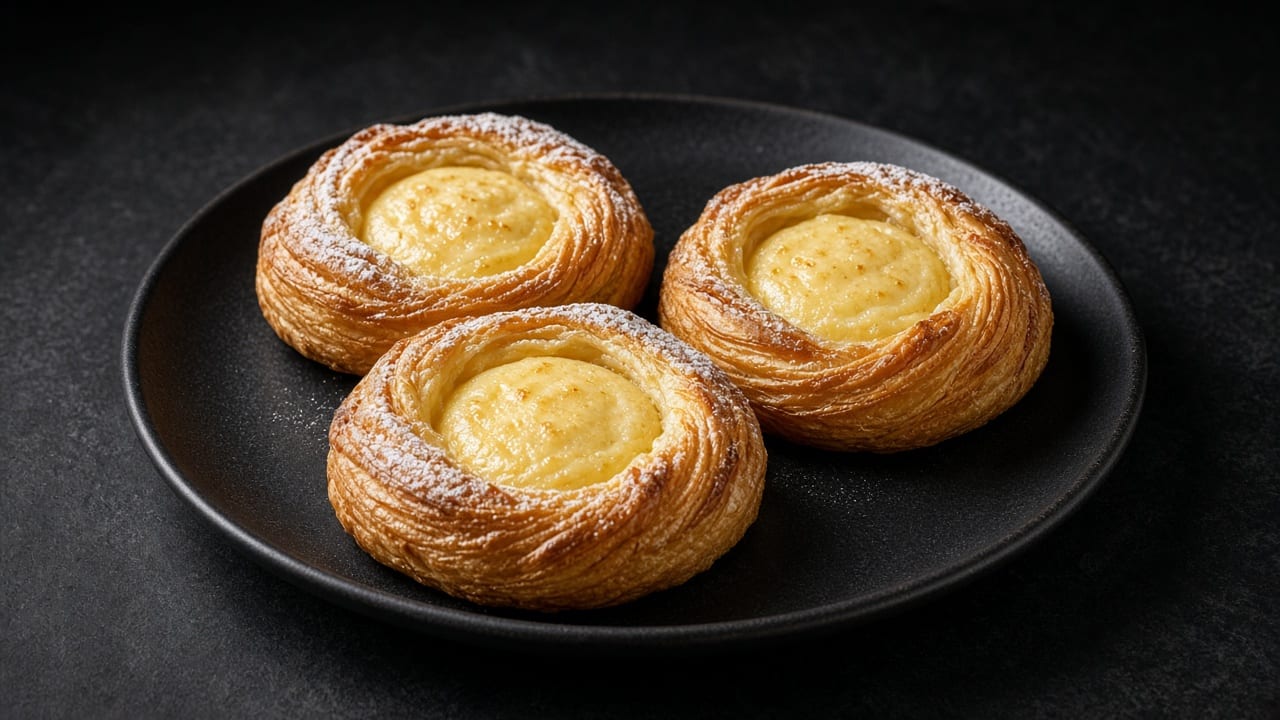
Sweet Cheese Danish Pastries with Lemon
Inspired by techniques from America's Test Kitchen, King Arthur Baking and NYT Cooking.
Buttery, laminated Danish pastries coiled into rosettes and filled with a lemony baked cream cheese and ricotta filling, dusted with icing sugar.
Always check the labels of the products you use.
Method
Unlock all flavours with Premium
This flavour is part of Premium. You can see the ingredients and nutrition; the quantities and the full method are for members.
Premium: $4.99/month or $39.99/year.
Equipment
- stand mixer with dough hook (or large bowl)
- rolling pin
- ruler
- baking paper
- cling film
- sharp knife or pizza wheel
- medium bowl
- 2 baking trays lined with baking paper
- pastry brush
- instant-read thermometer
- wire rack
Nutrition per serving (estimated values)
| Per serving | Amount |
|---|---|
| Energy | 393 kcal |
| Protein | 7.2 g |
| Carbohydrate | 38.1 g |
| of which sugars | 11 g |
| of which free sugars | 9.6 g |
| Fat | 23.7 g |
| of which saturates | 14.2 g |
| Fibre | 1.1 g |
| Salt | 0.69 g |
Protein per 100 kcal
1.8 g High Protein needs ≥ 10 g
Calculated from USDA FoodData Central ingredient values
Metric · 12 servings
Dough
- 400 g plain (all-purpose) flour plus more for rolling
- 50 g caster sugar
- 7 g instant (fast-action) dried yeast
- 6 g fine sea salt or table salt about 1 tsp
- ½ tsp ground cardamom
- 1 tsp vanilla
- 1 large egg
- 150 ml whole milk cold
- 50 ml water cold
- 25 g unsalted butter, softened
Butter block
- 200 g cold unsalted butter (high-fat, European-style)
Filling
- 200 g full-fat cream cheese
- 80 g ricotta, drained
- 50 g caster sugar
- 1 large egg yolk
- 1 tbsp cornflour
- 1 tsp finely grated lemon zest
- ½ tsp vanilla
Egg wash
- 1 large egg, beaten with 1 tbsp milk
To finish
- 15 g icing sugar, for dusting
- 1
Make the dough. In the bowl of a stand mixer, combine the flour, sugar, yeast, salt and cardamom; pour in the cold milk, water, egg and vanilla and add the softened butter. Knead with the dough hook for 4-5 minutes until the dough turns smooth and soft. Using cold liquids keeps the dough cool, which matters once the butter block goes in.
- 2
First chill. Press the dough into a rectangle about 2cm thick, wrap and chill for 2 hours, or overnight. A thorough chill firms the dough so it won't drag or soften the butter during the first roll.
- 3
Shape the butter block. Beat the cold butter between sheets of baking paper into a 15 x 15cm square, then chill for 20 minutes until it's firm but still bends rather than snaps. That bendy-but-firm texture is exactly what clean, even lamination needs.
- 4
Enclose the butter. Roll the dough out to 30 x 15cm, lay the butter over one half, fold the other half on top and pinch the edges together to seal. Sealing the edges now stops the butter escaping once rolling starts.
- 5
Roll and fold. Roll the dough to 45 x 20cm and fold it in thirds like a letter, then wrap and chill for 30 minutes; repeat this roll-and-fold twice more for three single turns altogether, chilling for longer between any turn where the butter feels soft or starts to smear. Each fold multiplies the thin layers of butter and dough that separate and puff in the oven.
- 6
Final chill. After the last fold, chill the dough for 1 hour so it's completely firm before shaping. Shaping warm, soft dough would blur the layers just built up.
- 7
Make the filling. Beat the cream cheese, drained ricotta, sugar, egg yolk, cornflour, lemon zest and vanilla together until smooth. The cornflour binds the extra moisture from the ricotta, so this larger amount of filling sets neatly instead of weeping as it bakes.
- 8
Shape the coils. Roll the chilled dough out to 36 x 30cm, roughly 5mm thick, then slice it into 12 strips of 2.5 x 30cm. Twist every strip several times, coil it loosely into a 9cm round, tuck the end underneath, then arrange the coils well spaced on the lined trays.
- 9
Prove. Cover the coils loosely and prove somewhere warm, between 24-26°C, for 1-1½ hours, until they look puffy and wobbly. Any hotter and the butter layers soften into the dough rather than staying distinct until baking.
- 10
Fill the centres. Press a deep 5cm well into the middle of each coil with the back of a floured spoon, brush the twisted rims with egg wash, then spoon a heaped 2 tbsp of filling into each well. The generous well holds this larger quantity of filling without it spilling over the twisted edges.
- 11
Bake. Heat the oven to 200°C (180°C fan) and bake for 16-20 minutes, until the pastry is deep golden and crisp at the edges and the filling looks puffed with pale gold spots and feels set. A thermometer should read at least 71°C in the centre of the filling and about 90°C in the pastry itself.
- 12
Cool and dust. Cool the pastries on the trays for 10 minutes, then move to a wire rack for at least 20 minutes so the filling finishes setting, and dust lightly with icing sugar just before serving. Dusting right before serving keeps the sugar looking crisp rather than melting into the warm filling.
Storage
Keep in the fridge because of the cream cheese filling, and eat on the day of baking for the best texture. Store airtight in the fridge for up to 1 day and refresh for 5 minutes in a 180°C oven until piping hot, or freeze baked pastries for up to 1 month. Cool leftovers in a shallow container and refrigerate within 2 hours (within 1 hour on a day above 32°C).