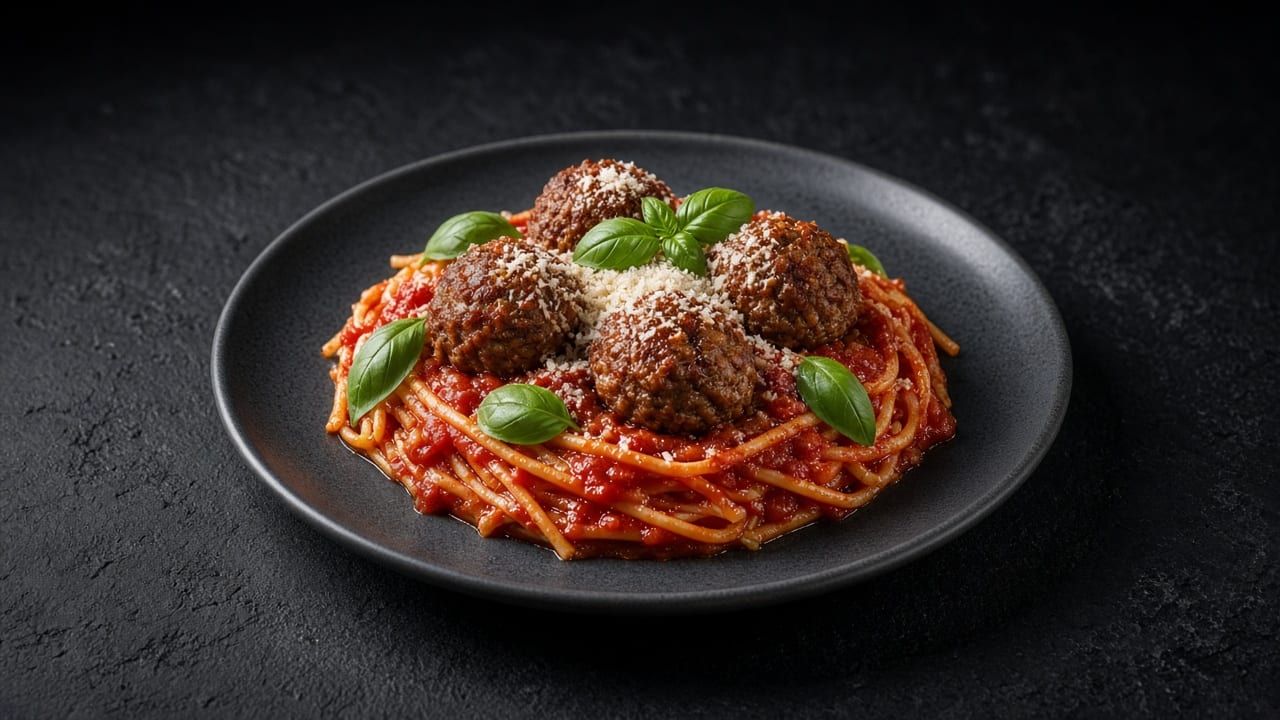
Spaghetti and Beef Meatballs in Tomato Sauce
Inspired by techniques from Serious Eats and America's Test Kitchen.
Tender beef meatballs simmered in a rich tomato sauce and served over spaghetti tossed in the same sauce.
Always check the labels of the products you use.
Method
- 1
Soak the Bread. Tear the bread into the milk and leave to soak for 10 minutes, then mash to a smooth paste. This paste, called a panade, holds onto moisture and keeps the beef proteins from tightening up, so the meatballs stay tender rather than turning dense and dry.
- 2
Mix the Meatball Mixture. Add the beef, Parmesan, egg, garlic, parsley, salt and pepper to the panade and mix with your hand just until everything is evenly combined. Mixing only briefly matters here, as overworking the mixture squeezes out moisture and makes the meatballs tough and dense rather than light.
- 3
Shape and Chill. Roll the mixture into 20 balls of about 45g each with wet hands, then chill for 15 minutes to firm up. Chilling helps the meatballs hold their shape in the pan rather than flattening or falling apart as they brown.
- 4
Brown the Meatballs. Heat 2 tbsp of the oil in the pan over medium-high heat and brown the meatballs in two batches for 5-6 minutes, turning, until crusted on several sides, then set them aside and pour off all but 1 tbsp of the fat. Browning here is purely for flavour, building a deep crust through the Maillard reaction; the meatballs will finish cooking through in the sauce.
- 5
Start the Sauce. Lower the heat, add the remaining 1 tbsp of oil and the garlic, and cook for 30-60 seconds until pale gold. Add the tomatoes, scraping up the browned bits stuck to the pan as you stir, then bring to a simmer. Those browned bits hold concentrated flavour from the meatballs, and scraping them into the sauce means nothing is wasted.
- 6
Simmer the Meatballs in Sauce. Return the meatballs to the pan, cover and simmer gently for 15 minutes, turning once, until the centre of the largest meatball reaches 71°C. Simmering gently finishes cooking the meatballs through while keeping them moist, and checking the temperature is the only reliable way to know the beef is properly cooked. Tear in the basil once done.
- 7
Cook the Spaghetti. Bring 3 litres of water to the boil with the 15g salt, a light 0.5% since the tinned tomatoes and Parmesan already bring salt, and cook the spaghetti for 1 minute less than the packet time.
- 8
Toss Pasta with Sauce. Reserve 240ml of the pasta water and drain the spaghetti, then toss it in a large ladle of sauce, without meatballs, with 60ml of the water over medium heat for 1 minute until coated. Tossing the pasta in sauce before plating, rather than just spooning sauce over at the end, means every strand is properly coated rather than just the top layer.
- 9
Serve. Serve the sauced spaghetti topped with the meatballs, extra sauce and grated Parmesan.
Storage
Keep covered in the fridge for up to 3 days, or freeze the meatballs and sauce, separately from the pasta, for up to 3 months. Reheat gently on the stove or in the microwave, stirring occasionally, until piping hot and the centre of the meatballs reaches at least 74°C. Cool leftovers in a shallow container and refrigerate within 2 hours (within 1 hour on a day above 32°C).
Equipment
- large bowl
- tray lined with baking paper
- large deep frying pan or sauté pan with lid (30 cm)
- instant-read thermometer
- large pot (at least 5 litres)
- colander or tongs
- heatproof mug for pasta water
Nutrition per serving (estimated values)
| Per serving | Amount |
|---|---|
| Energy | 827 kcal |
| Protein | 40.5 g |
| Carbohydrate | 79.8 g |
| of which sugars | 11 g |
| of which free sugars | 0.7 g |
| Fat | 38.4 g |
| of which saturates | 12.9 g |
| Fibre | 6.1 g |
| Salt | 2.71 g |
Protein per 100 kcal
4.9 g High Protein needs ≥ 10 g
Calculated from USDA FoodData Central ingredient values