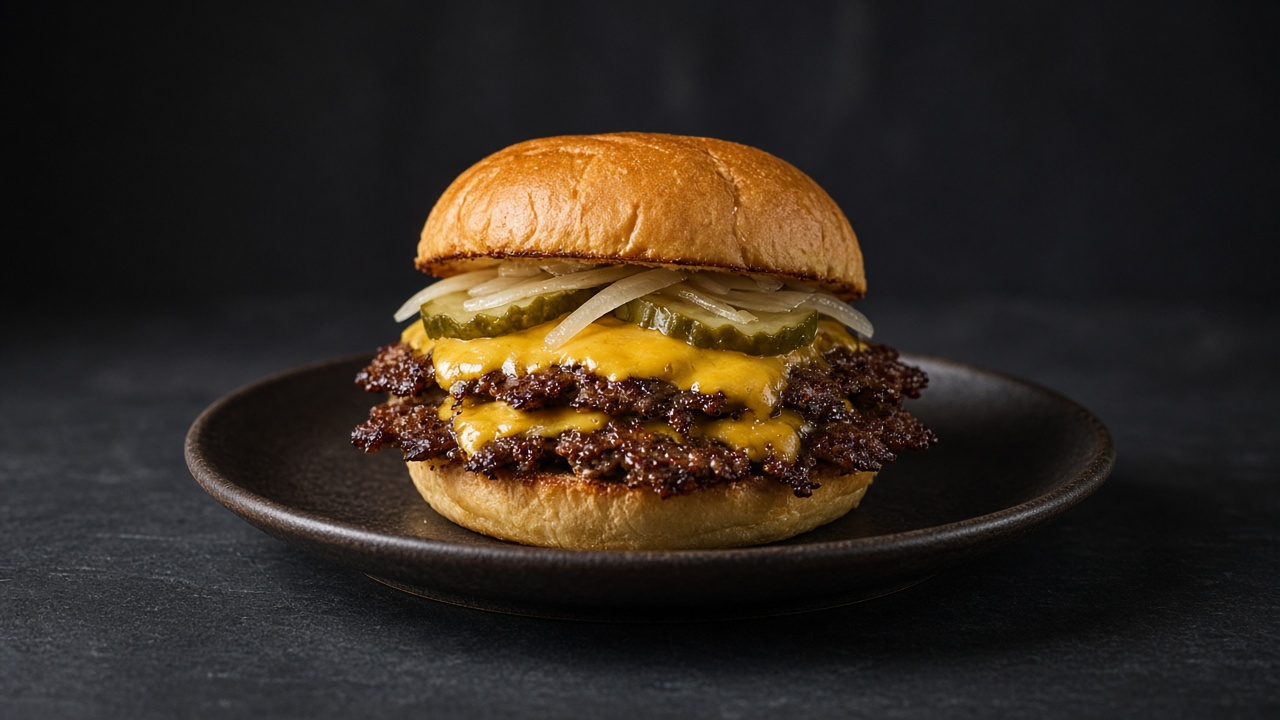
Smashed Burgers
Inspired by techniques from America's Test Kitchen.
Two ultra-thin, lacy-edged beef patties get smashed hard in a screaming-hot pan and stacked with melted cheese, crisp lettuce and a tangy pickle sauce for a true diner-style burger.
Always check the labels of the products you use.
Method
- 1
Mix the sauce. Stir together the mayonnaise, ketchup, chopped dill pickles, mustard and garlic powder in a small bowl, then cover and chill while you cook the burgers. Resting gives the sharp pickle and mustard time to meld into the mayonnaise, so the sauce tastes rounded rather than sharp.
- 2
Portion the beef. Cold, fridge-fresh mince divides most easily into 8 loose balls of about 60 g each — handle it as little as possible. Keep the balls chilled until the pan is ready, because cold fat melts more slowly, so more of it stays inside the thin patty and keeps it juicy. Overworking the mince, meanwhile, is what makes patties dense.
- 3
Toast the buns. Butter the cut sides of the buns and toast them cut-side down in a dry pan over medium heat for 1-2 minutes until golden, then set aside and wipe the pan clean. A toasted surface seals the crumb, so the sauce sits on top rather than soaking in and turning the bun soggy.
- 4
Heat the pan. A dry pan over high heat for 4-5 minutes is all you need — it's ready once a drop of water flicked onto the surface skitters and vanishes instantly. No oil is required at this stage, since the beef's own fat renders as soon as it touches the heat.
- 5
Smash the patties. Working with 2-3 balls at a time and plenty of space between them, lay a square of baking paper over each ball and press down hard with a spatula — using a second utensil on top for extra leverage — until it's about 6 mm thick. This single smash should happen early, in the first 20-30 seconds, while the meat is still cold, since pressing later only squeezes out the juices. Peel away the paper, season the tops with salt and pepper, and press on a few onion slices if using.
- 6
Sear hard. Left completely untouched for 2-2.5 minutes, the patties develop lacy, deep brown edges as juices pool on top. This browning, known as the Maillard reaction, is what builds the flavour, so resist peeking underneath too soon. Scrape firmly under the crust with the spatula edge to flip, bringing the onions underneath.
- 7
Melt the cheese. Cheese goes onto half the patties straight away, with a further 45-60 seconds of cooking. By this point the beef is cooked through, with no pink remaining, clear juices, and a core temperature of 71°C if you check it. Stack a plain patty on top of each cheesy one to build the double layer.
- 8
Build and serve. Spread sauce on both bun halves, then layer on the lettuce, the stacked double patty and pickle slices if you like them, finishing with the top bun. Serve immediately, while the cheese is still molten and the crust is at its crispest.
Storage
These burgers are best eaten fresh from the pan. Raw portioned balls can be covered and kept in the fridge for up to 1 day. Cooked patties keep in the fridge for 2 days; reheat in a hot pan until piping hot (74°C). The sauce keeps for up to 4 days in the fridge. Cool leftovers in a shallow container and refrigerate within 2 hours (within 1 hour on a day above 32°C).
Equipment
- large cast-iron or heavy steel frying pan (at least 26 cm) or flat griddle
- stiff metal spatula (fish slice or burger turner)
- baking paper
- small bowl
Nutrition per serving (estimated values)
| Per serving | Amount |
|---|---|
| Energy | 694 kcal |
| Protein | 30.8 g |
| Carbohydrate | 35.7 g |
| of which sugars | 7 g |
| of which free sugars | 5.8 g |
| Fat | 46.9 g |
| of which saturates | 16.9 g |
| Fibre | 1.8 g |
| Salt | 3.07 g |
Protein per 100 kcal
4.4 g High Protein needs ≥ 10 g
Calculated from USDA FoodData Central ingredient values