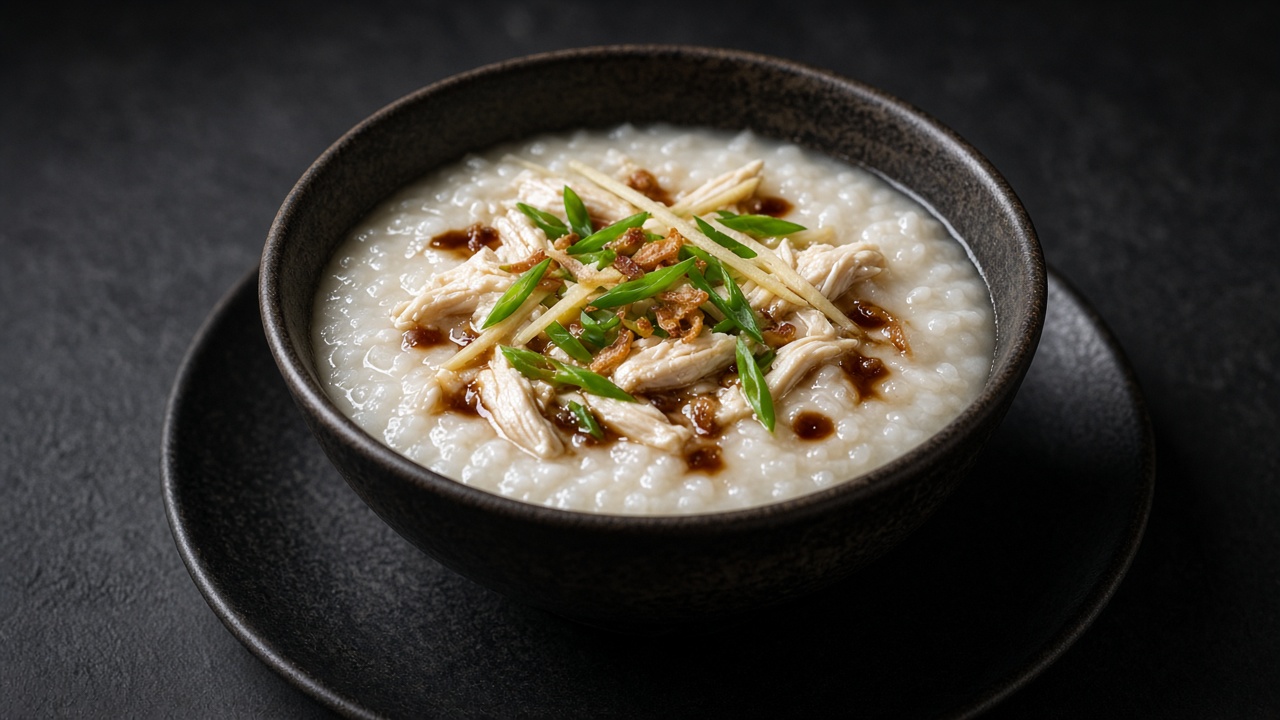
Silky Rice Congee with Ginger, Crispy Shallots and Spring Onion
Inspired by techniques from Serious Eats, America's Test Kitchen and NYT Cooking.
A gently simmered, silky rice porridge enriched with ginger and finished with crisp fried shallots, spring onion and a savoury drizzle of soy and sesame oil.
Always check the labels of the products you use.
Method
- 1
Rinse the rice. Rinse the rice in a sieve under cold running water until the water runs almost clear. This clears away loose surface starch that would otherwise make the congee gluey rather than smoothly creamy once the grains break down.
- 2
Bring everything to a boil. Put the rinsed rice, stock, 1.5 litres water, ginger slices and salt into the large pan and bring to a boil over high heat, stirring now and then so nothing catches on the base. Starting the rice in a flavoured liquid means the grains absorb seasoning as they cook, rather than trying to season a finished porridge afterwards.
- 3
Simmer low and slow. Turn the heat down to a steady gentle simmer, rest the lid ajar (a wooden spoon laid across the pan under the lid stops it boiling over) and cook for 60-75 minutes, stirring every 10 minutes and scraping the base. It's ready when the grains have broken down into a thick, glossy, creamy porridge; add up to 250 ml more water along the way if it gets thicker than a loose porridge. The long, gentle simmer ruptures the rice grains so their starch spills into the liquid, which is what gives congee its characteristic silky thickness. Fish out the ginger slices once it's done.
- 4
Fry the crispy shallots. While the congee simmers, put the sliced shallots and oil into a cold frying pan, set it over medium heat and cook, stirring, for 5-8 minutes until evenly golden and crisp; they colour quickly in the last minute, so watch closely. Lift onto kitchen paper with a slotted spoon and keep the flavoured oil. Starting them in cold oil lets the moisture inside the shallots evaporate gradually, so they crisp through evenly instead of browning outside while staying soft in the middle.
- 5
Serve. Ladle the congee into bowls and top with the crispy shallots, a spoonful of the shallot oil, the sliced spring onions, a few drops each of soy sauce and sesame oil, and a pinch of white pepper. Serve straight away while hot, since congee keeps thickening as it sits and the toppings are best added fresh for contrast and crunch.
Storage
Congee thickens as it cools; refrigerate within 1 hour and use within 24 hours. Reheat gently with a splash of water, stirring, until it's bubbling and piping hot (74°C) before serving. Cool leftovers in a shallow container and refrigerate within 2 hours (within 1 hour on a day above 32°C).
Equipment
- fine sieve
- large heavy saucepan or casserole (at least 4 litres) with a lid
- wooden spoon
- small frying pan
- slotted spoon
- kitchen paper
Nutrition per serving (estimated values)
| Per serving | Amount |
|---|---|
| Energy | 272 kcal |
| Protein | 4.6 g |
| Carbohydrate | 36.7 g |
| of which sugars | 2.8 g |
| of which free sugars | 0 g |
| Fat | 11.9 g |
| of which saturates | 1 g |
| Fibre | 1.7 g |
| Salt | 2.28 g |
Protein per 100 kcal
1.7 g High Protein needs ≥ 10 g
Calculated from USDA FoodData Central ingredient values