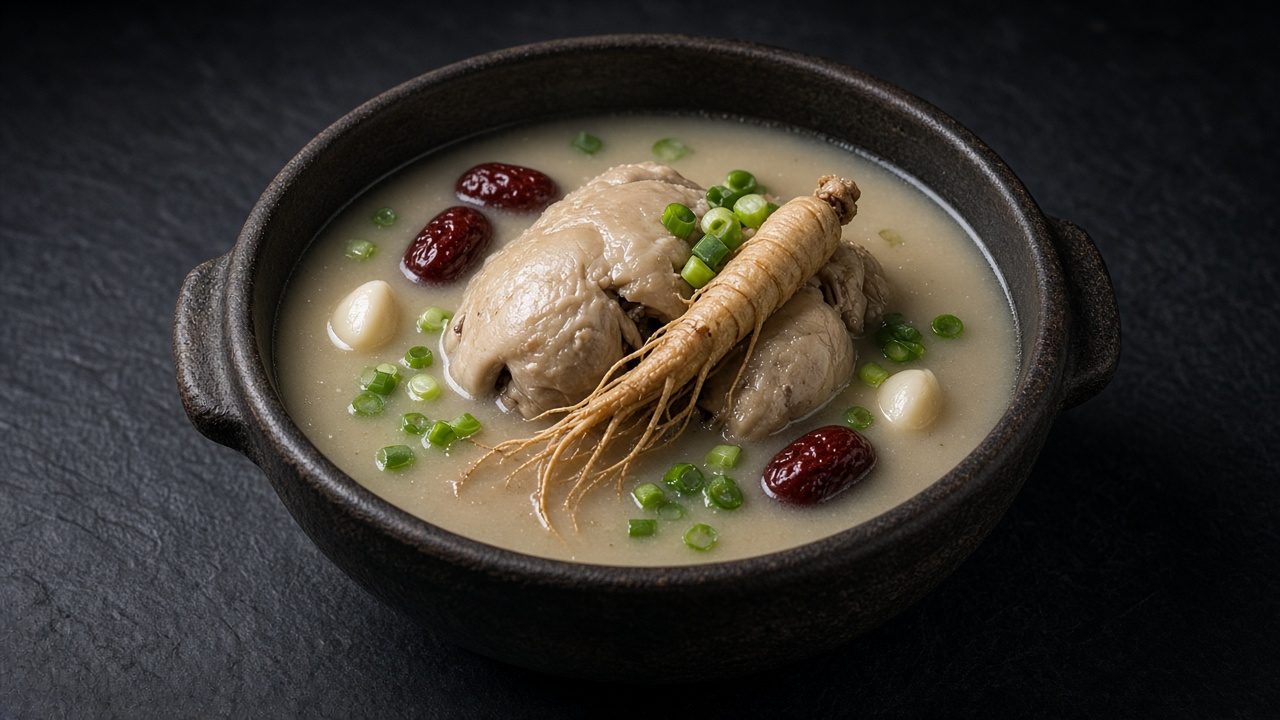
Samgyetang (Korean Ginseng Chicken Soup)
Inspired by techniques from NYT Cooking and Serious Eats.
Whole poussins are stuffed with glutinous rice, jujubes and garlic, then simmered with ginseng and ginger until the meat is tender and the rice inside has cooked through.
None of the 14 major EU allergens. Always check the labels of the products you use.
Method
- 1
Prepare rice and chicken. Soak the glutinous rice for 1 hour, then drain. Rinse the poussins and trim away any excess fat around the cavity, so the stuffing has room and the broth doesn't turn greasy.
- 2
Stuff the birds. Fill each cavity with half the rice, 2 jujubes and 3 garlic cloves, packing loosely rather than tightly since the rice will swell as it cooks. Cross the legs and secure with a skewer or kitchen string so the stuffing stays put during simmering.
- 3
Start the broth. Put the stuffed birds into the large pot with the ginseng, ginger, and the remaining jujubes and garlic, then add water to cover. Bring to a boil over high heat and skim off any foam that rises to the surface, which keeps the broth clear.
- 4
Simmer gently. Once the foam is skimmed, reduce the heat to a gentle simmer, partly covered, and cook for 60-75 minutes. The chicken is ready once the legs wiggle loosely, the rice inside is soft when checked with a skewer, and the thigh meat is well above 74°C.
- 5
Serve. Skim off any excess fat if you like a cleaner broth, then serve each half bird - split at the table - in a deep bowl with plenty of broth, the jujubes and garlic. Scatter spring onions over the top, with salt and pepper left on the table so everyone can season their own bowl, since the broth itself is deliberately left unsalted.
Storage
Fridge for up to 2 days; because of the rice, this doesn't freeze especially well, so it's best eaten fresh. Reheat gently on the hob until piping hot and the chicken reaches 74°C throughout. Cool leftovers in a shallow container and refrigerate within 2 hours (within 1 hour on a day above 32°C).
Why it's healthy
34 g protein for 294 kcal = 11.6 g per 100 kcal. Our High Protein label needs at least 10 g per 100 kcal. How we decide
- Total fat: 21.1 % of energy (limit ≤ 30%)
- Saturated fat: 5.5 % of energy (limit < 10%)
- Free sugars: 0 % of energy (limit < 10%)
- Salt: 1.26 g (limit ≤ 1.7 g)
- Fibre or fruit & veg: 1.1 g fibre / 113 g veg (limit ≥ 3.7 g fibre or 80 g fruit & veg)
Per serving, worked out from the nutrition table against our WHO-based rule. Not endorsed by WHO.
Equipment
- large deep pot with lid (at least 5 litres)
- wooden or metal skewers or kitchen string
- ladle
- instant-read thermometer
Nutrition per serving (estimated values)
| Per serving | Amount |
|---|---|
| Energy | 294 kcal |
| Protein | 34 g |
| Carbohydrate | 21.8 g |
| of which sugars | 0.4 g |
| of which free sugars | 0 g |
| Fat | 6.9 g |
| of which saturates | 1.8 g |
| Fibre | 1.1 g |
| Salt | 1.26 g |
Protein per 100 kcal
11.6 g meets the High Protein rule (≥ 10 g)
Calculated from USDA FoodData Central ingredient values