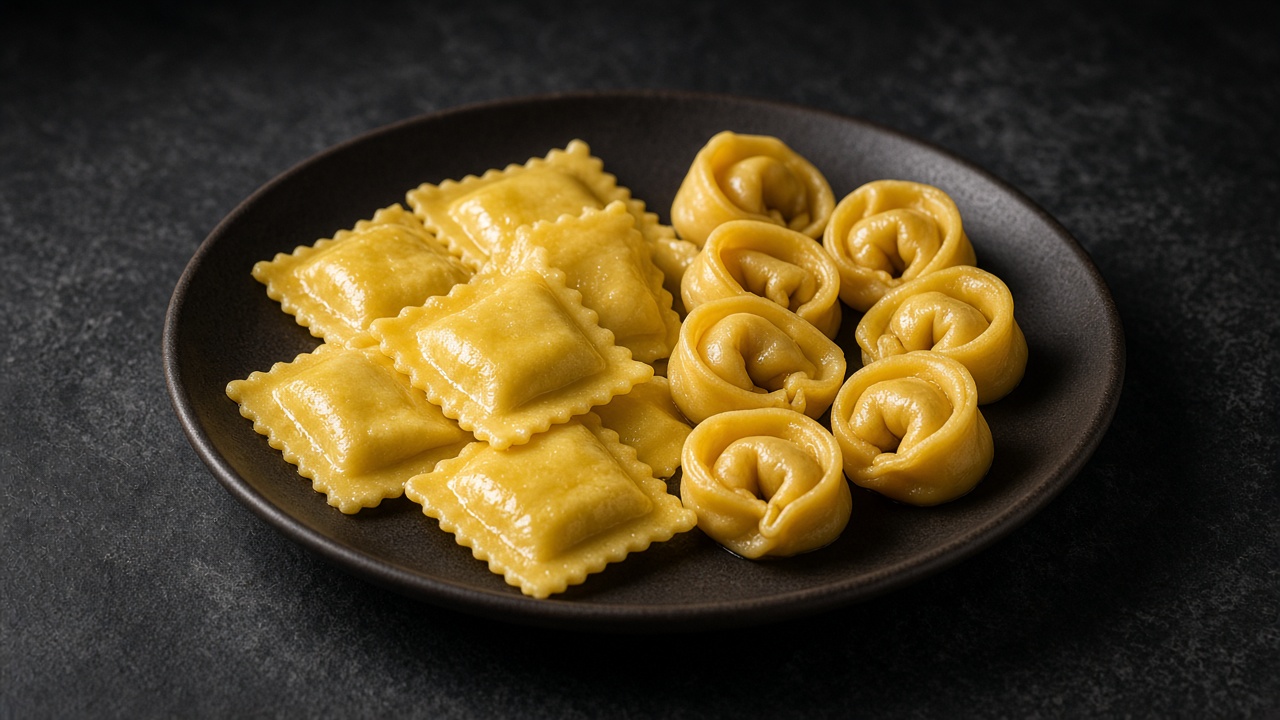
Ricotta Ravioli with Butter and Parmesan
Inspired by techniques from Serious Eats and NYT Cooking.
Fresh egg pasta squares filled with a lemony ricotta and Parmesan mixture, finished simply in melted butter so the filling stays the focus.
Always check the labels of the products you use.
Method
- 1
Mix the dough. Tip the flour onto the worktop and shape a mound with a 12cm well in the middle, then add the eggs, yolks and salt. Beat with a fork, drawing flour in from the inner wall until a soft paste forms, then fold in the rest using a bench scraper. Building the dough gradually like this stops it turning into a sticky, unworkable mass.
- 2
Knead until smooth. Knead for 8-10 minutes, pushing forward with the heel of your hand and folding the dough back on itself, until it feels smooth, firm and springs back slowly when poked. The egg, at around 67% of the flour's weight, gives a firm, silky dough once the gluten network has developed fully. Wet your hands if the dough cracks, or dust in a teaspoon of flour at a time if it feels tacky.
- 3
Rest the dough. Wrap the dough and leave it at room temperature for 30-60 minutes. This gives the gluten time to relax and the flour time to hydrate fully, so it rolls out smoothly instead of shrinking back.
- 4
Drain the ricotta. Spread the ricotta between two clean tea towels on a tray, press down firmly and leave for 10 minutes. Removing this excess water keeps the filling firm enough to hold its shape and stops it making the pasta soggy or bursting through as it cooks.
- 5
Season the filling. Mix the drained ricotta with the Parmesan, lemon zest, nutmeg, salt and pepper, then chill while you roll out the dough. A cold, firm filling is easier to spoon into neat mounds later.
- 6
Roll thin sheets. Cut the dough into 4 pieces, keeping what you're not using covered, and roll each piece through the pasta machine down to the thinnest or second-thinnest setting, under 1mm and translucent. Keep every sheet covered as you go, since rolling the dough this thin means the doubled edges of each ravioli won't turn chewy.
- 7
Fill and seal. Lay a sheet flat and spoon 2 tsp mounds of filling 5cm apart across one half, then brush water around each mound before folding the other half of the sheet over. Press out all the air around each mound, working from the filling outward to the edge, since any trapped air will expand in the boiling water and burst the ravioli open.
- 8
Cut and rest. Cut between the mounds with the fluted pasta wheel to make squares of about 5-6 cm, pressing the edges again to be sure they're sealed, then lay the ravioli on semolina-dusted trays without letting them touch. Repeat with the remaining sheets until you have about 36-40 ravioli.
- 9
Cook in batches. Bring 4 litres of water to the boil with the 32g of salt, and melt the butter in a frying pan over low heat. Cook the ravioli in 2 batches at a gentle boil for 3-4 minutes, until the edges feel tender, then lift them straight into the butter pan with a slotted spoon along with 120ml of the cooking water.
- 10
Toss and serve. Swirl the pan over medium heat for 1 minute until the butter and starchy water come together into a glossy coating around the ravioli. The agitation emulsifies the fat and water rather than leaving them as separate puddles. Serve straight away with the Parmesan scattered over.
Storage
Uncooked ravioli keep in the fridge for up to 1 day on a floured tray, or freeze in a single layer for up to 1 month, cooking straight from frozen with an extra minute. Reheat any cooked leftovers gently in a little butter until piping hot. Cool leftovers in a shallow container and refrigerate within 2 hours (within 1 hour on a day above 32°C).
Equipment
- clean worktop or large board
- fork
- bench scraper
- cling film
- 2 clean tea towels and a baking tray
- pasta machine (or long rolling pin)
- pastry brush and small bowl of water
- fluted pasta wheel (or a sharp knife)
- 2 baking trays dusted with semolina
- large pot (at least 5 litres)
- slotted spoon
- large frying pan (30 cm)
Nutrition per serving (estimated values)
| Per serving | Amount |
|---|---|
| Energy | 719 kcal |
| Protein | 30.7 g |
| Carbohydrate | 69.8 g |
| of which sugars | 0.9 g |
| of which free sugars | 0 g |
| Fat | 34.5 g |
| of which saturates | 19.5 g |
| Fibre | 2.2 g |
| Salt | 2.44 g |
Protein per 100 kcal
4.3 g High Protein needs ≥ 10 g
Calculated from USDA FoodData Central ingredient values