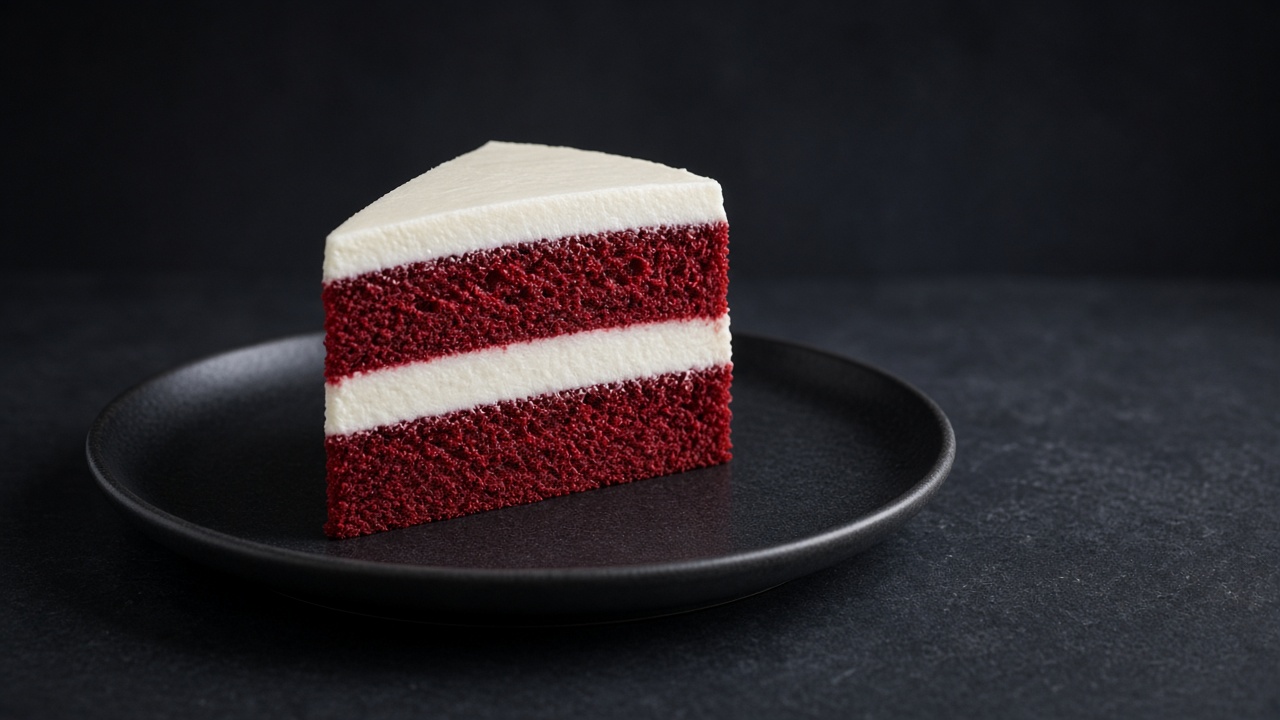
Red Velvet Cake
Inspired by techniques from Serious Eats and NYT Cooking.
Two vividly red, buttermilk-soft layers with a light cocoa flavour, finished with cream cheese frosting.
Always check the labels of the products you use.
Method
- 1
Heat the oven. Preheat the oven to 175°C (155°C fan), allowing at least 20 minutes, and position a shelf in the centre. These shallow sponge layers need the oven fully up to temperature to rise quickly and evenly.
- 2
Mix the dry ingredients. Whisk the flour, cocoa, bicarbonate of soda and salt together in a bowl. Clearing out any lumps now means the cocoa blends in smoothly later instead of leaving dark specks through the crumb.
- 3
Whisk the wet ingredients. Whisk the oil and sugar together, then whisk in the eggs one at a time, followed by the buttermilk, food colouring, vanilla and vinegar. The acidity in the buttermilk and vinegar reacts with the bicarbonate of soda to help the cake rise, and that same acidity is part of what keeps a red velvet crumb so soft and fine.
- 4
Combine the batters. Whisk the dry mix into the wet ingredients just until smooth, with no streaks of flour or colouring left. Mixing only until smooth avoids developing too much gluten, which would make the cake springy rather than tender.
- 5
Divide and bake. Divide the batter between the two tins and bake for 25-30 minutes, until the sponges spring back when pressed lightly and a skewer inserted into the centre comes out clean. These layers are thinner than many cakes, so start checking near the earlier end of the time to avoid overbaking.
- 6
Cool completely. Let the sponges rest in their tins for 10 minutes before turning them out onto a wire rack, where they should cool fully before the frosting goes on. Frosting warm sponge would melt the butter in the cream cheese mixture and make it slide straight off.
- 7
Make the frosting. Beat the butter alone until smooth, then add the cream cheese and beat just until combined before mixing in the icing sugar, vanilla and salt on low speed. Beating the cream cheese too much breaks it down and leaves the frosting too soft to hold its shape, so stop as soon as it's smooth; chill for 15 minutes if needed.
- 8
Level and assemble. Trim the domed tops off both sponges with a serrated knife, saving the trimmings. Sandwich the layers with a third of the frosting, then cover the top and sides with the rest, smoothing it with a palette knife, and crumble the reserved trimmings over the top if you like.
Storage
Keep the frosted cake covered in the fridge for up to 4 days. Unfrosted sponge layers freeze well, wrapped tightly, for up to 2 months.
Equipment
- two 20 cm round cake tins (5 cm deep), greased and base-lined
- 2 bowls and a whisk
- stand mixer or electric hand whisk
- wire racks
- palette knife
- serrated knife
Nutrition per serving (estimated values)
| Per serving | Amount |
|---|---|
| Energy | 613 kcal |
| Protein | 6 g |
| Carbohydrate | 66.8 g |
| of which sugars | 47.5 g |
| of which free sugars | 45.5 g |
| Fat | 36.7 g |
| of which saturates | 11.3 g |
| Fibre | 1.1 g |
| Salt | 0.85 g |
Protein per 100 kcal
1 g High Protein needs ≥ 10 g
Calculated from USDA FoodData Central ingredient values