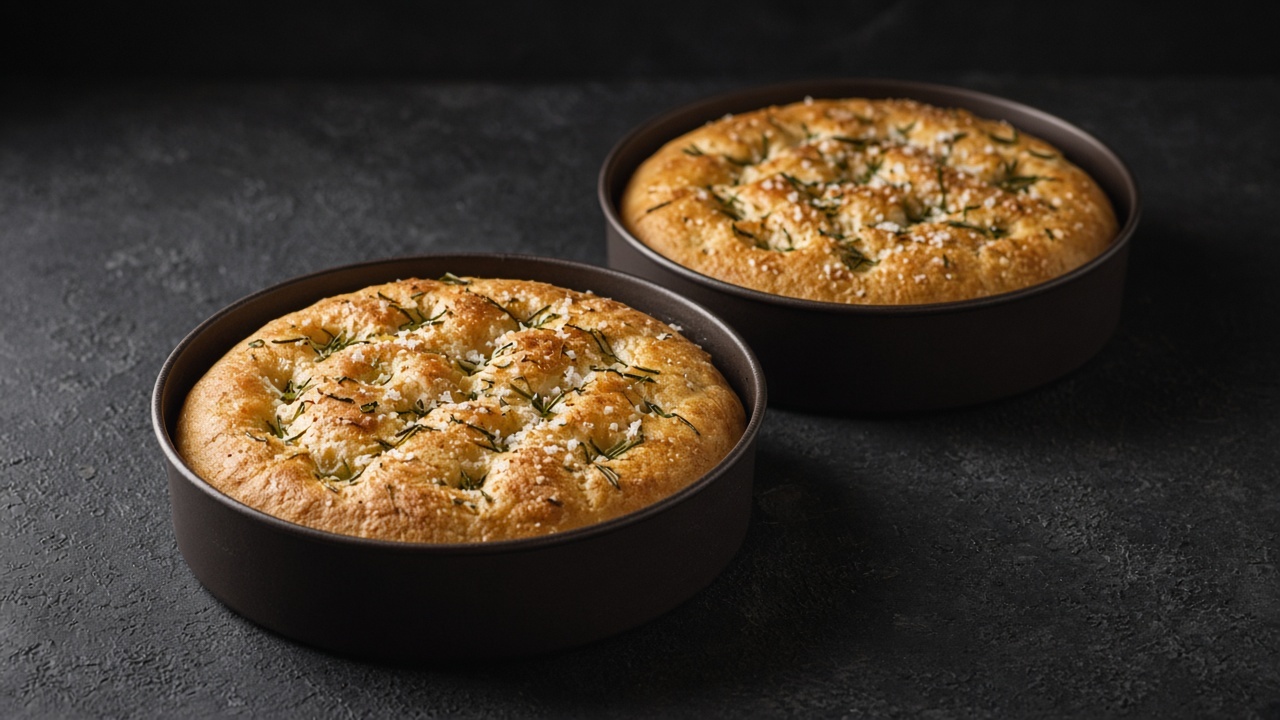
Overnight Rosemary Focaccia
Inspired by techniques from America's Test Kitchen.
Two crisp-bottomed rounds of focaccia built on an overnight starter, with rosemary through the crumb and across the top.
Always check the labels of the products you use.
Method
Unlock all flavours with Premium
This flavour is part of Premium. You can see the ingredients and nutrition; the quantities and the full method are for members.
Premium: $4.99/month or $39.99/year.
Equipment
- large bowl
- spatula or wooden spoon
- cling film or a clean tea towel
- two 23 cm round metal cake tins (not loose-bottomed)
- wire rack
- probe thermometer (optional)
Nutrition per serving (estimated values)
| Per serving | Amount |
|---|---|
| Energy | 202 kcal |
| Protein | 5.2 g |
| Carbohydrate | 30.5 g |
| of which sugars | 0.1 g |
| of which free sugars | 0 g |
| Fat | 6.4 g |
| of which saturates | 0.9 g |
| Fibre | 1.2 g |
| Salt | 0.94 g |
Protein per 100 kcal
2.6 g High Protein needs ≥ 10 g
Calculated from USDA FoodData Central ingredient values
Metric · 12 servings
Starter
- 100 g strong white bread flour
- 100 ml water room temperature
- 1 g instant (fast-action) dried yeast a scant 1/4 tsp
Dough
- 400 g strong white bread flour
- 280 ml water lukewarm, about 38 °C
- 5 g instant (fast-action) dried yeast
- 10 g fine sea salt about 1⅔ tsp
- 2 tbsp fresh rosemary needles, chopped half for the dough, half for the top
Tins and topping
- 5 tbsp extra-virgin olive oil 4 tbsp (2 tbsp per tin) for the tins, 1 tbsp for drizzling
Topping
- ½ tsp flaky sea salt
- 1
Starter. In a large bowl stir 100 g flour, 100 ml room-temperature water and the 1 g yeast into a thick paste. Cover and leave on the worktop 8-24 h, until domed and full of bubbles; this slow ferment builds a rounder, gently tangy flavour.
- 2
Dough. Add the remaining 400 g flour, the 280 ml lukewarm water, the 5 g yeast and half the rosemary, and mix until no dry flour is left. Cover for 15 min, then scatter over the fine salt and squeeze it through with a wet hand.
- 3
Folds. Every 30 min for 1 1/2 h, lift one edge of the dough and lay it over the middle, working four times round the bowl. By the last set the dough feels smooth, elastic and wobbly with air.
- 4
Tins. Pour 2 tbsp oil into each tin, halve the dough and turn each piece over in its oil. After 15 min, ease the dough out to the edges and cover again.
- 5
Proof. Leave 45-60 min, until puffy and a fingertip dent fills back slowly. Meanwhile heat the oven to 230 °C (210 °C fan) with a shelf low down.
- 6
Dimple and bake. Drizzle with the last 1 tbsp oil, press oiled fingertips right down to the base all over, then scatter the rest of the rosemary and the flaky salt. Bake 22-26 min, swapping the tins halfway, until deep gold with a crisp, almost fried base; the centre reads about 96 °C.
- 7
Cool. Slide the breads out onto a rack within 2 min so the bases stay crisp, and wait 20 min before cutting each into 6 wedges.
Storage
Best eaten the day it is baked. Wrap leftovers and keep at room temperature for up to 2 days, then crisp at 200 °C for 5 min; or freeze wedges for up to 1 month. Cool leftovers in a shallow container and refrigerate within 2 hours (within 1 hour on a day above 32°C).