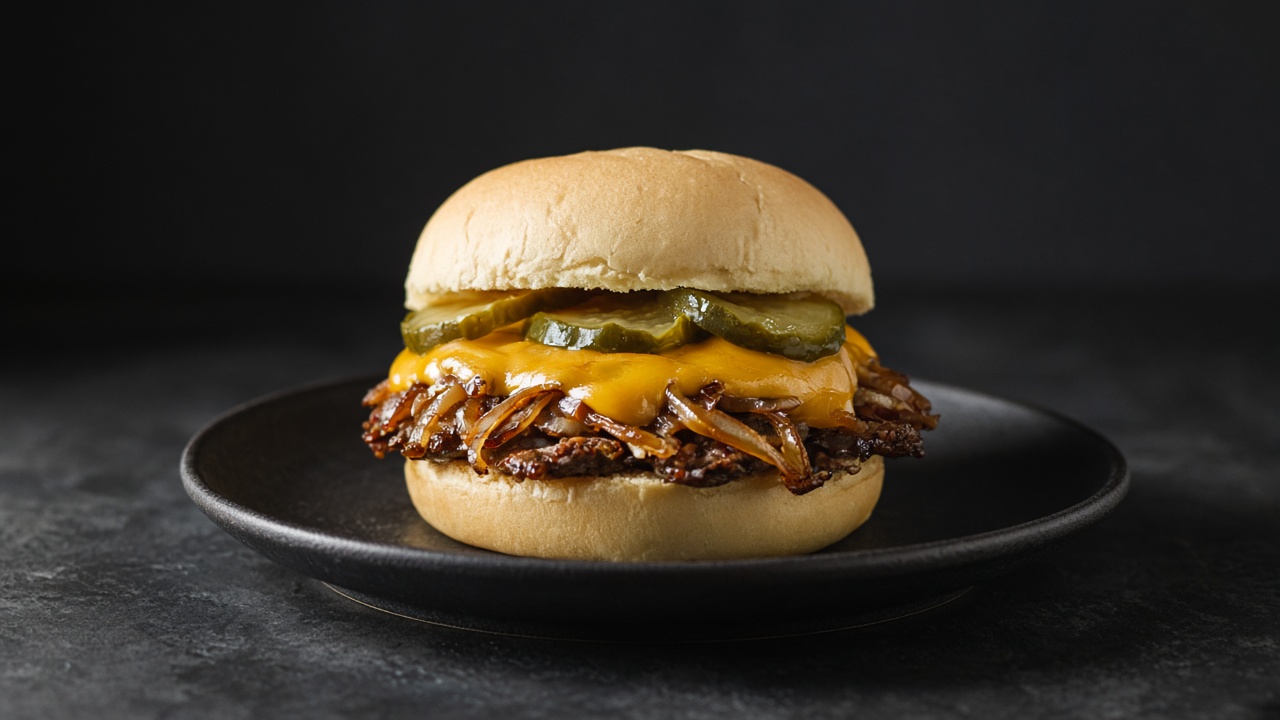
Oklahoma Onion Burger
Inspired by techniques from Serious Eats and America's Test Kitchen.
Thin beef patties are smashed straight through a heap of paper-thin onion, so the onion fries sweet and golden in the beef fat, then go into a toasted bun with yellow mustard and pickles, the way the classic Oklahoma diner burger is served.
Always check the labels of the products you use.
Method
- 1
Wilt the onions. Slice the yellow onions as thinly as you can manage, ideally on a mandoline, then toss them with a small pinch of the salt. Leave them for a few minutes while you prep everything else; the salt starts drawing out moisture so they soften faster once they hit the heat. Thin, limp onions are the whole trick here - anything thicker won't cook through in the short searing time.
- 2
Toast the buns. Butter the cut sides of the buns and toast them cut-side down in the dry pan over medium heat for 1-2 minutes until golden, then set them aside and wipe the pan. A toasted surface seals the crumb so the mustard and juices don't soak in and turn it soggy.
- 3
Get the pan properly hot. Turn the wiped pan up to high and heat it for 4-5 minutes with nothing in it. Flick in a drop of water: if it skitters across the surface and vanishes almost instantly, you're ready. A pan this hot is what gives the lacy, deep-brown crust that defines a smash burger, rather than a patty that just steams in its own juices.
- 4
Pile on onions and smash. Lower 2-3 of the 60g beef balls into the pan, spaced well apart, and top each one with a 35-40g haystack of the salted onion. Lay a square of baking paper over the top and press down hard with a spatula, using a second utensil for extra leverage, flattening everything to about 6mm within the first 20-30 seconds. This single hard press drives the onion into the meat and maximises contact with the pan - don't press again, or you'll squeeze out the juices that keep it tender.
- 5
Season the tops. Peel away the baking paper and scatter salt and pepper over the exposed meat. Seasoning now rather than before cooking keeps the salt from drawing moisture out of the raw mince while it sits around. The onion side is already pressed in and doesn't need seasoning of its own.
- 6
Sear undisturbed. Leave the patties alone for 2-2.5 minutes so a deep, lacy brown crust can build underneath. Resist the urge to peek or nudge them; moving a patty too soon tears the crust before it's properly formed. The edges turning dark and crisp-looking is your cue that it's ready to turn.
- 7
Flip, then melt the cheese. Scrape firmly under each patty with a thin spatula to lift the whole crust in one go, then flip so the onions now sit against the hot pan. Lay a slice of cheese on half the patties straight away and cook for about 1 minute more, until the onions underneath turn soft, sweet and lightly charred in the rendered beef fat. The beef is done when no pink remains, the juices run clear and the core reads 71°C; stack each plain patty on a cheesy one.
- 8
Steam the top bun. For the last 30 seconds in the pan, rest a toasted top bun on each double stack. The steam rising from the onions softens the bun slightly, a nod to the soft-steamed buns of the original diner style, while the bottom bun stays crisp. Wipe out excess fat between batches if the pan starts to smoke.
- 9
Build the burger. Spread 1 tsp of yellow mustard over each toasted bottom bun and add a few pickle slices. Lift on the double patty with its charred onions, then cap with the steamed top bun. Skip any other sauce: sharp mustard and pickles are exactly what this burger needs.
Storage
Leftover cooked patties keep in an airtight container in the fridge for up to 2 days, or frozen for up to 2 months; thaw fully in the fridge before reheating. Reheat gently in a hot pan until piping hot throughout and the core reaches 74°C. Assemble fresh buns and onions each time, as they turn soggy if stored together. Cool leftovers in a shallow container and refrigerate within 2 hours (within 1 hour on a day above 32°C).
Equipment
- large cast-iron or heavy steel frying pan (at least 26 cm) or flat griddle
- stiff metal spatula (fish slice or burger turner)
- baking paper
- small bowls
- mandoline or very sharp knife
Nutrition per serving (estimated values)
| Per serving | Amount |
|---|---|
| Energy | 599 kcal |
| Protein | 31.2 g |
| Carbohydrate | 38.9 g |
| of which sugars | 7.8 g |
| of which free sugars | 4.4 g |
| Fat | 34.8 g |
| of which saturates | 14.6 g |
| Fibre | 2.8 g |
| Salt | 2.95 g |
Protein per 100 kcal
5.2 g High Protein needs ≥ 10 g
Calculated from USDA FoodData Central ingredient values