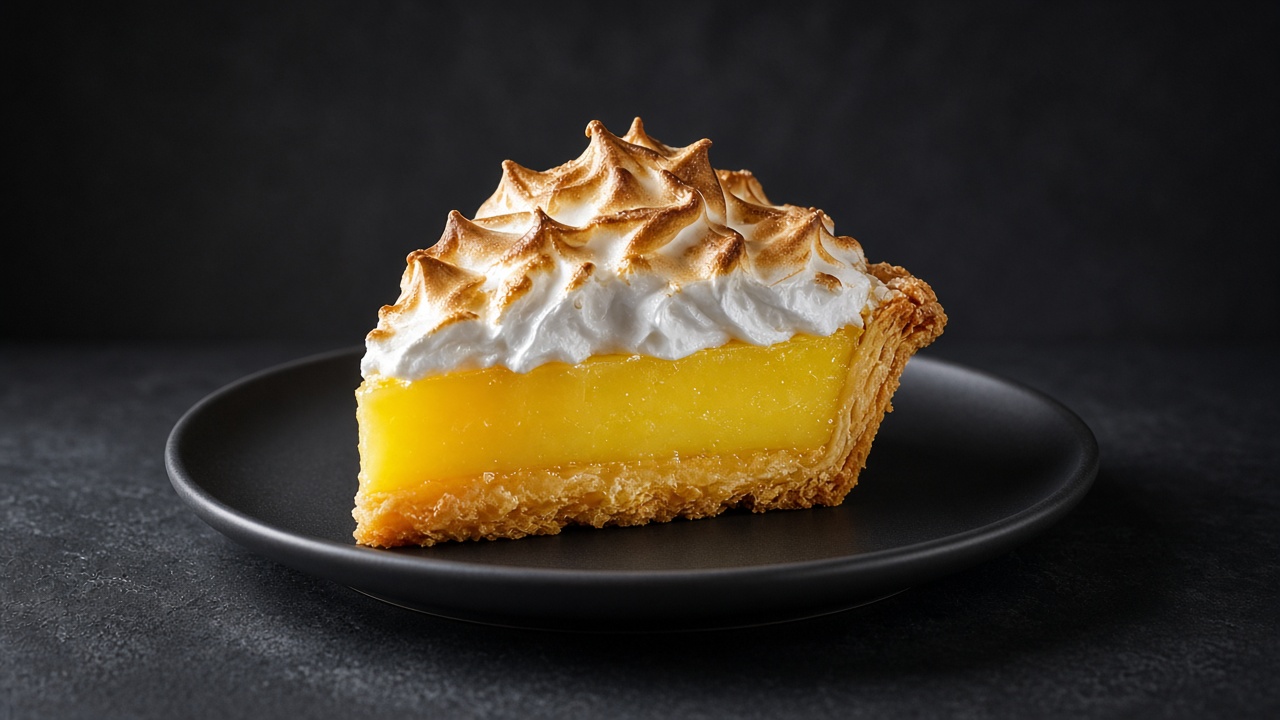
Lemon Meringue Pie
Inspired by techniques from America's Test Kitchen and Food Network Kitchen.
A blind-baked shell with a bright, tart lemon filling, sealed under a stable cooked meringue that is swirled high and torched golden.
Always check the labels of the products you use.
Method
- 1
Prepare the dough. Rub the 120 g cold butter into the 180 g flour, sugar and salt until it looks like coarse crumbs with some pea-size pieces. Mix in the 60 ml ice-cold water until the dough just holds, plus up to 15 ml more if dry. Wrap as a disc and chill 1 h.
- 2
Shape the case. Roll out to a 30 cm round about 3 mm thick on a floured surface and settle it into the 23 cm pie dish. Leave a 1 cm overhang, fold it under and crimp. Chill 30 min so the pastry is firm before it meets the heat.
- 3
Blind bake the case. At 190 °C (170 °C fan), prick the base, cover with baking paper and baking beans and bake 20 min. Lift away the paper and beans and continue 8-12 min until golden all over. A crisp, well-browned base stands up to the wet lemon filling.
- 4
Make the lemon filling. Whisk the sugar, cornflour and salt in the saucepan, whisk in the water and bring to a simmer over medium heat, whisking, until thick and clear. Whisk the yolks in a bowl, whisk in about half the hot mixture in a thin stream, then whisk it all back into the pan and simmer 1 min, stirring constantly, until very thick (well above 71 °C). Off the heat stir in the zest, lemon juice and butter; adding the acid last keeps it from weakening the starch. Pour straight into the shell and cover the surface with cling film.
- 5
Cook the meringue. Whisk the whites, sugar and cream of tartar in the heatproof bowl set over simmering water, whisking constantly, until the sugar dissolves and the mixture reads 71 °C, 3-5 min. Off the heat add the vanilla and whip on high speed 5-6 min to stiff, glossy peaks. Heating the sugar into the whites makes a dense, stable meringue that is less likely to weep.
- 6
Seal and swirl. Remove the cling film and spread the meringue over the warm filling so it touches the crust all the way round. Anchoring it to the pastry stops it shrinking back, and the warm filling helps set the underside. Pull up swirls and peaks with the spatula.
- 7
Toast the peaks. Brown the peaks with the blowtorch, or slide under a hot grill (broiler) for 1-2 min until golden. Watch closely under the grill, as sugar-rich meringue goes from golden to scorched in seconds.
- 8
Let it set. Cool at room temperature 2 h, then chill at least 2 h until the filling slices cleanly. Cut into 8 with a knife dipped in hot water so the meringue does not drag. Keep chilled and eat within 2 days.
Storage
Keep loosely covered in the fridge and eat within 2 days; the meringue softens over time. It does not freeze well.
Equipment
- mixing bowl or food processor
- rolling pin
- 23 cm pie dish (about 4 cm deep)
- baking paper
- baking beans or dry rice
- baking tray
- wire rack
- medium heavy saucepan
- whisk
- heatproof bowl that sits over a pan of simmering water
- instant-read thermometer
- electric whisk or stand mixer
- offset spatula
- kitchen blowtorch (optional)
Nutrition per serving (estimated values)
| Per serving | Amount |
|---|---|
| Energy | 436 kcal |
| Protein | 6.3 g |
| Carbohydrate | 61.6 g |
| of which sugars | 39.6 g |
| of which free sugars | 39.3 g |
| Fat | 18.8 g |
| of which saturates | 10.9 g |
| Fibre | 0.8 g |
| Salt | 0.55 g |
Protein per 100 kcal
1.4 g High Protein needs ≥ 10 g
Calculated from USDA FoodData Central ingredient values