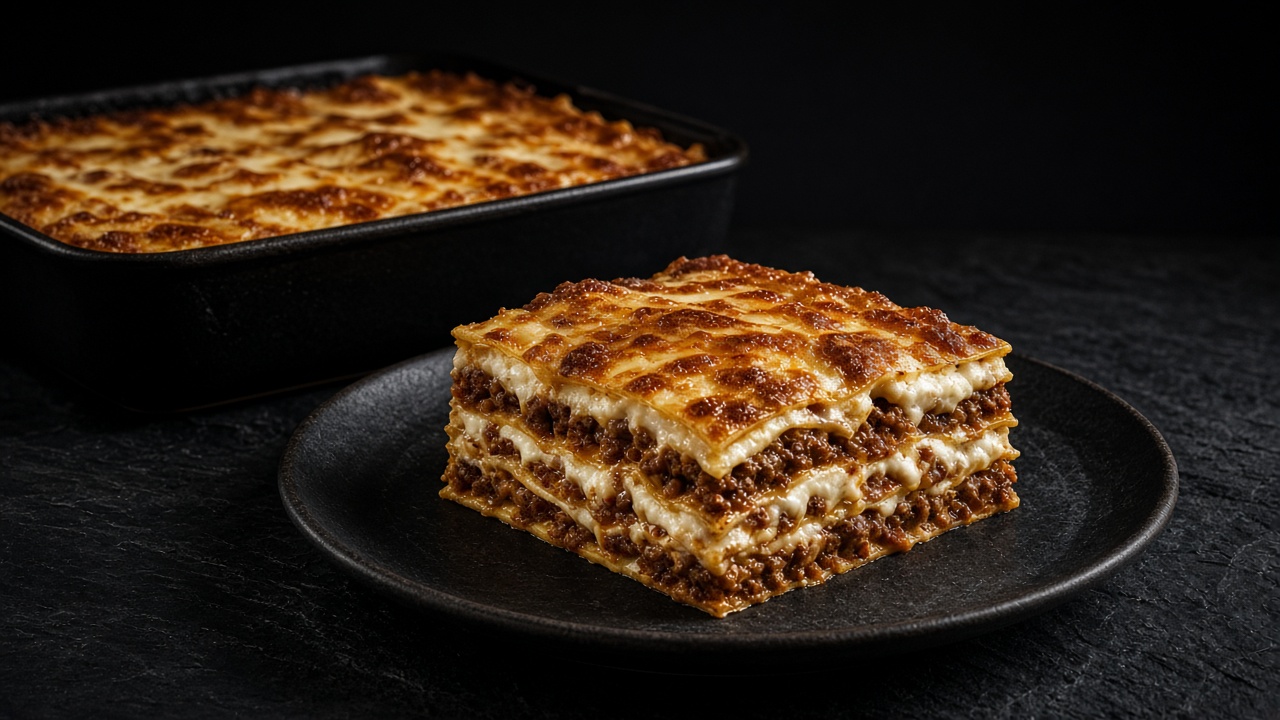
Lasagne Bolognese (Beef Ragù and Béchamel)
Inspired by techniques from NYT Cooking, Serious Eats and America's Test Kitchen.
A classic baked lasagne built on a long-simmered beef ragù and a smooth béchamel, layered with no-precook sheets and plenty of Parmesan.
Always check the labels of the products you use.
Method
- 1
Soften the vegetables. Melt the butter with the olive oil in the casserole over medium heat, then add the chopped onion and cook for 5 minutes until translucent. Stir in the carrot and celery and cook for a further 3 minutes, until they soften and the kitchen starts to smell sweet. This slow start builds a mellow base flavour before the meat goes in.
- 2
Cook the beef through. Add the minced beef, salt and pepper, breaking the meat up well with a spoon as it cooks for 6-8 minutes until no pink remains. Beef mince needs to reach an internal temperature of 71°C to be safely cooked through, and crumbling it finely here keeps it tender rather than letting it clump into tough lumps later.
- 3
Simmer with milk. Pour in the milk and let it bubble away, stirring occasionally, for 10-15 minutes until it has almost entirely reduced. The milk's proteins tenderise and soften the meat before the acidity of the tomatoes is introduced, which is why it goes in first. Grate in the nutmeg once the milk has nearly gone.
- 4
Add tomatoes and simmer long. Stir in the crushed tomatoes and bring everything to a bubble, then turn the heat right down to the barest simmer and leave uncovered for 2½-3 hours. Stir every 20-30 minutes and add a splash of the water whenever it looks like it's starting to catch. The ragù is ready when it's thick and glossy with fat pooling on top, yet still loose enough to spread, since the no-precook sheets need that moisture to soften as they bake; taste and adjust the salt before setting aside.
- 5
Make the béchamel. Melt the butter for the béchamel in a saucepan over medium heat, whisk in the flour and cook for 1-2 minutes without letting it colour. Gradually whisk in the milk, then simmer, whisking often, for 5 minutes until the sauce thickens enough to coat the back of a spoon. Stir in the nutmeg and salt at the end.
- 6
Preheat and prepare the dish. Preheat the oven to 200°C (180°C fan) at least 20 minutes before baking, and butter the baking dish well so the layers don't stick to the base. A fully heated oven from the start helps the lasagne cook evenly rather than drying out at the edges while the centre lags behind.
- 7
Layer the lasagne. Spread a thin layer of béchamel over the base of the dish, then lay sheets of pasta over the top, breaking them to fit without overlapping. Spoon over a quarter of the ragù, followed by a fifth of the béchamel and a fifth of the Parmesan, then repeat the whole sequence four times in total, finishing with a layer of sheets, the last of the béchamel and a scattering of Parmesan.
- 8
Bake covered then open. Cover the dish tightly with foil and bake for 20 minutes, then remove the foil and bake for a further 20-25 minutes until the top is golden and bubbling fiercely at the edges. The sheets are ready when a knife slides through with no resistance, and the centre should read 74°C to confirm it's piping hot all the way through.
- 9
Rest before slicing. Let the lasagne stand for 15 minutes once out of the oven before cutting into it. This short rest allows the layers to firm up and set, so each portion lifts out in a clean slice instead of collapsing into a puddle of sauce.
Storage
Cover and refrigerate for up to 3 days, or freeze portions for up to 3 months. Reheat in the oven or microwave until the centre reaches 74°C and is piping hot throughout. Cool leftovers in a shallow container and refrigerate within 2 hours (within 1 hour on a day above 32°C).
Equipment
- large heavy casserole or wide saucepan (at least 4 litres)
- medium saucepan
- whisk
- baking dish about 23 x 33 cm, at least 6 cm deep
- foil
- instant-read thermometer
Nutrition per serving (estimated values)
| Per serving | Amount |
|---|---|
| Energy | 588 kcal |
| Protein | 29.3 g |
| Carbohydrate | 46.3 g |
| of which sugars | 12 g |
| of which free sugars | 0 g |
| Fat | 31.6 g |
| of which saturates | 15.8 g |
| Fibre | 4 g |
| Salt | 2.16 g |
Protein per 100 kcal
5 g High Protein needs ≥ 10 g
Calculated from USDA FoodData Central ingredient values