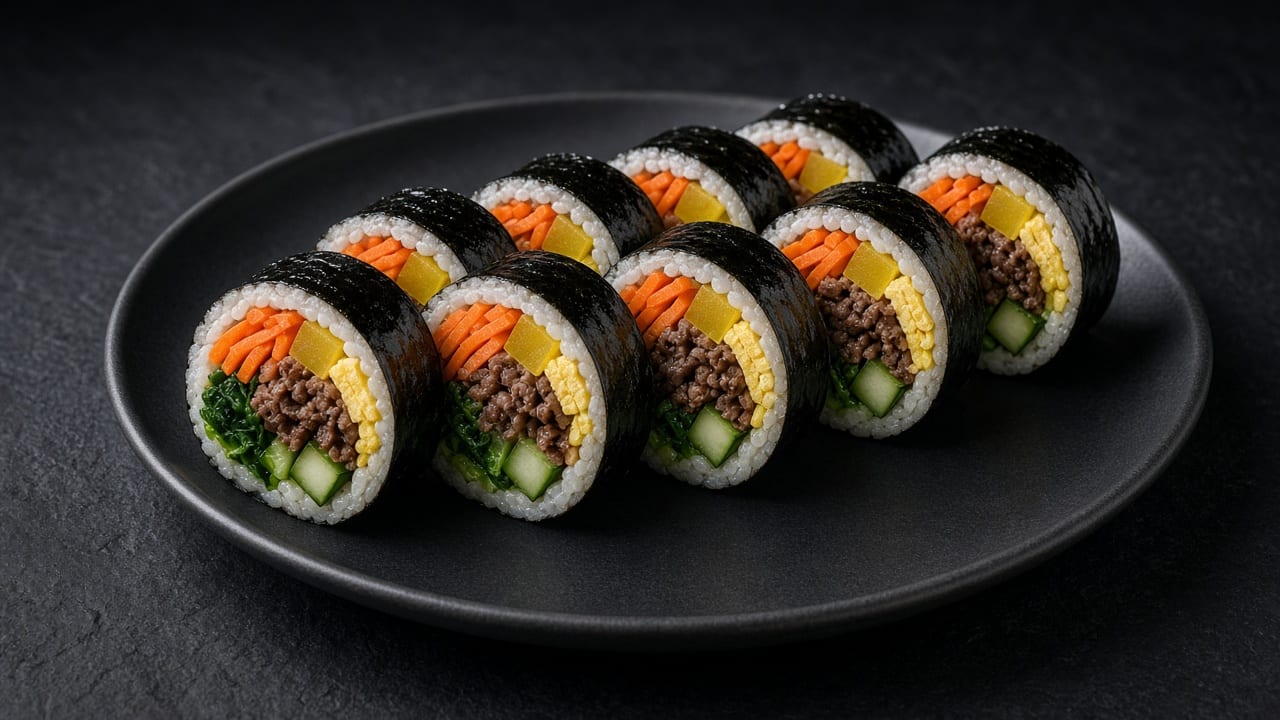
Korean Seaweed Rice Rolls with Beef, Egg and Vegetables
Inspired by techniques from Serious Eats and NYT Cooking.
These seaweed rice rolls layer warm sesame rice with savoury beef, a silky egg sheet, blanched spinach, sweet quick-pickled daikon, carrot and cucumber for a balanced, colourful bite in every slice. They take a little assembly but reward you with a batch of four rolls perfect for sharing.
Always check the labels of the products you use.
Method
- 1
Quick pickle the daikon. Put the daikon batons into the heatproof container, then stir the rice vinegar, hot water, sugar, salt and turmeric together until the sugar has fully dissolved. Pour the liquid over the daikon, cover and leave for at least 30 minutes (or up to 2 days in the fridge), turning the batons once so they colour evenly. The warm brine softens the radish slightly while the vinegar and sugar balance each other into a clean sweet-sharp bite; drain well before using.
- 2
Wash and soak the rice. Wash the rice 3-4 times in cold water, swirling and draining each time until the water runs almost clear, then soak it for 30 minutes and drain for a further 15 minutes. Rinsing washes away surface starch that would otherwise make the grains gluey, while soaking lets water penetrate the grain so it cooks through evenly. Properly drained rice also holds its shape better once rolled.
- 3
Cook the rice. Put the drained rice in the medium saucepan with the 420 ml water, cover with a tight lid and bring to the boil over medium heat. Lower the heat and cook gently for 12-13 minutes, then take it off the heat and leave it covered, undisturbed, for 10 minutes. This resting time lets trapped steam finish softening the grains evenly, so keep the lid on throughout rather than lifting it to check.
- 4
Season the rice. Tip the cooked rice into the large bowl and gently fold in the sesame oil, salt and toasted sesame seeds, working carefully so the grains stay whole rather than mashed. Keep the bowl covered with a damp cloth as you prepare the other fillings. The rice should feel just warm, not hot, by the time you roll, since hot rice can steam and soften the nori until it tears.
- 5
Blanch the spinach. Drop the spinach into a pan of boiling unsalted water for 45 seconds, then lift it straight into cold water to stop the cooking. Squeeze the leaves very dry with your hands, as trapped water will make the rolls soggy, then toss the spinach with its sesame oil and salt. The brief blanch is just enough to wilt the leaves while keeping their bright green colour and gentle bite.
- 6
Brown the beef. Heat half the oil in the frying pan over medium-high heat, add the beef and cook for 5-6 minutes, breaking it up as it goes, until it is evenly browned and cooked through to 71°C on a probe thermometer. Stir in the soy sauce, sugar, grated garlic, sesame oil and pepper and cook for a further 1-2 minutes until no liquid remains in the pan. Spread the beef out on a plate to cool quickly and stop it steaming the rice later.
- 7
Cook the carrot. Wipe out the pan, add the remaining oil and cook the carrot matchsticks with their salt over medium heat for 1-2 minutes, just until they soften slightly but still have some crunch. Spread them out to cool. Keeping a little bite in the carrot gives the finished roll texture rather than a uniformly soft filling.
- 8
Make the egg sheet. Beat the eggs with the salt until smooth, lightly oil the non-stick frying pan and pour in the egg over medium-low heat, swirling the pan so it spreads into a thin, even sheet. Cook for about 2 minutes until the base is set, then flip and cook for a further 1 minute until the egg is completely set with no liquid egg remaining and reaches 71°C. Let it cool fully before cutting it into 1 cm strips, as a cooled sheet slices cleanly without tearing.
- 9
Assemble the rolls. Lay a nori sheet shiny side down on the rolling mat and, with damp fingers, spread a quarter of the rice (about 175 g) evenly over the bottom two-thirds of the sheet. Arrange a quarter of the spinach, cucumber, beef, egg strips, pickled daikon and carrot in neat rows across the rice closest to you. Lift the near edge of the mat and roll it firmly away from you, tucking the filling in as you go, then dampen the exposed strip of nori to seal the roll completely; repeat to make 4 rolls in total.
- 10
Slice and serve. Brush each roll lightly with sesame oil, then cut it into 8 slices with a sharp knife, wiping the blade with a damp cloth between cuts so it glides through rather than dragging the rice. A thin coat of oil also gives the nori a glossy finish and a little extra flavour. Eat within 2 hours at room temperature, or wrap and refrigerate within 1 hour and finish within 24 hours.
Storage
Kimbap is best eaten within 2 hours at room temperature; if not finished by then, wrap and refrigerate within 1 hour and eat within 24 hours. It isn't suitable for freezing, as the rice turns hard and the vegetables release water on thawing; if you do warm leftovers, make sure any reheated filling is piping hot (74°C) throughout before eating.
Equipment
- heatproof container with a lid
- large bowl
- sieve
- medium saucepan with a tight lid
- medium saucepan for blanching
- frying pan
- 25 cm non-stick frying pan
- instant-read probe thermometer
- bamboo rolling mat (or a tea towel covered with cling film)
- sharp knife
- small bowl of water
Nutrition per serving (estimated values)
| Per serving | Amount |
|---|---|
| Energy | 615 kcal |
| Protein | 25.3 g |
| Carbohydrate | 77.5 g |
| of which sugars | 12 g |
| of which free sugars | 8.2 g |
| Fat | 21.9 g |
| of which saturates | 5.2 g |
| Fibre | 4 g |
| Salt | 2.23 g |
Protein per 100 kcal
4.1 g High Protein needs ≥ 10 g
Calculated from USDA FoodData Central ingredient values