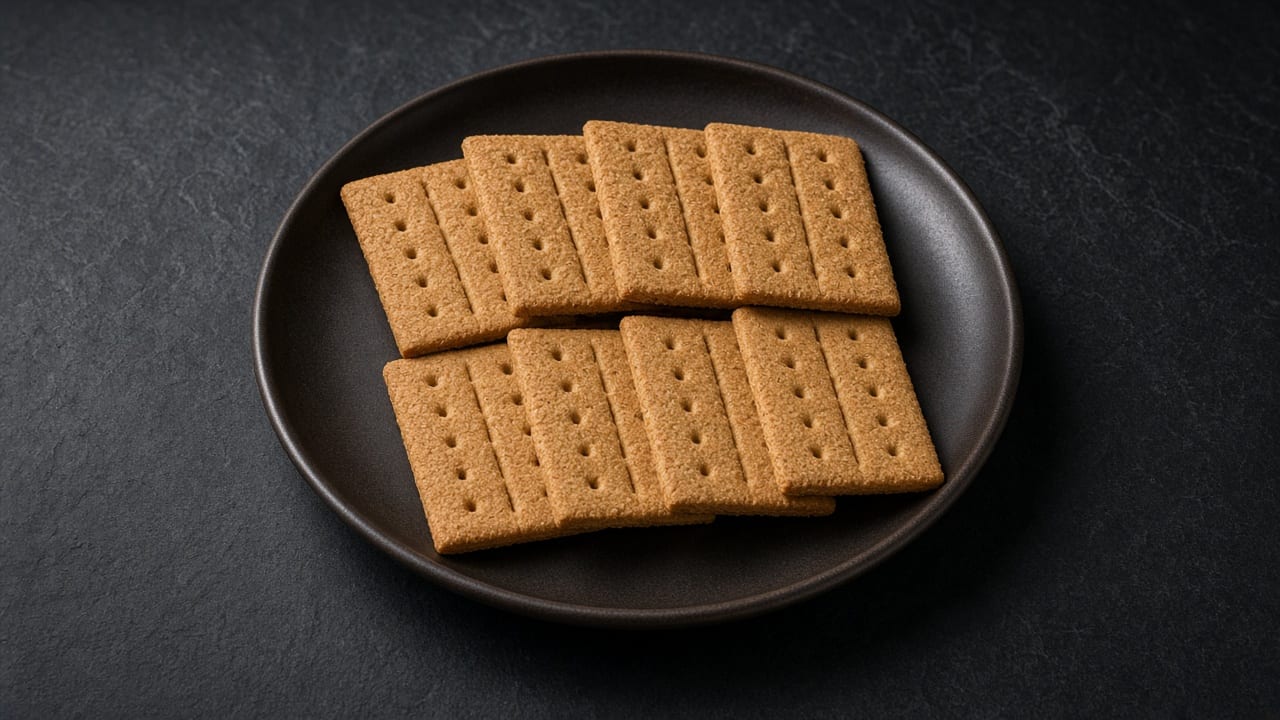
Graham Crackers
Inspired by techniques from King Arthur Baking, America's Test Kitchen and NYT Cooking.
Thin, snappy wholemeal crackers spiced with cinnamon and sweetened with honey, baked until crisp.
Always check the labels of the products you use.
Method
- 1
Combine the dry ingredients. Pulse the wholemeal flour, plain flour, sugar, cinnamon, salt, baking powder and bicarbonate of soda together in a food processor, or whisk them in a large bowl. Mixing the leaveners evenly through the flour now means they'll act consistently across the whole batch rather than leaving pockets of rise. Add the cold, cubed butter and pulse until the mixture looks like fine crumbs.
- 2
Add the wet ingredients. Add the honey, milk and vanilla, then pulse or mix until the dough starts to clump together. Using cold butter right up to this point keeps tiny flecks of fat intact in the dough, which is part of what gives these crackers their crisp, flaky snap rather than a soft texture. Stop as soon as the dough comes together — it doesn't need to look perfectly smooth.
- 3
Chill the dough. Press the dough into two flat rectangles, wrap, and chill for 1 hour. Chilling firms the butter back up and relaxes the dough, making it far easier to roll out thinly without it springing back or tearing. This rest also lets the wholemeal flour fully hydrate.
- 4
Heat the oven. Put a shelf in the middle of the oven and heat it to 175°C (155°C fan), allowing at least 20 minutes. Line two large metal trays with baking paper while the oven comes up to temperature. A fully heated oven helps the thin dough crisp quickly rather than drying out slowly.
- 5
Roll and score. Roll each piece of dough between sheets of baking paper to about 3 mm thick, into a rectangle roughly 20 x 28 cm, then slide it, still on its bottom sheet, onto a tray. Trim the edges, score the dough into 7 x 6 cm rectangles without cutting all the way through, then prick all over with a fork and sprinkle with the cinnamon sugar. Rolling the dough thin and even is what makes these crackers snap cleanly rather than bend, and the fork pricks let steam escape so the dough doesn't bubble up unevenly.
- 6
Bake until golden. Bake for 14-18 minutes, rotating the trays halfway through, until the crackers are golden brown and firm at the edges. Rotating halfway compensates for any hot spots in the oven, so every cracker browns at roughly the same rate. The edges should feel properly firm, not just coloured, before you take them out.
- 7
Re-cut and cool. While the crackers are still warm, cut back along the scored lines so they separate cleanly, then leave them on the tray for 10 minutes. Cutting warm dough along the scores works far more easily than trying to snap a fully cooled sheet apart. Transfer to a wire rack, where they'll crisp up fully as they finish cooling — the thin, even rolling is really what gives them their final snap.
Storage
Store in an airtight tin at room temperature for up to 2 weeks. They freeze well for up to 2 months; recrisp briefly in a low oven after thawing if needed.
Equipment
- 2 large metal baking trays lined with baking paper
- food processor or large bowl
- rolling pin
- baking paper for rolling
- ruler and sharp knife or pizza wheel
- fork or skewer for docking
- wire rack
Nutrition per serving (estimated values)
| Per serving | Amount |
|---|---|
| Energy | 77 kcal |
| Protein | 1.2 g |
| Carbohydrate | 11.7 g |
| of which sugars | 4.7 g |
| of which free sugars | 4.6 g |
| Fat | 3.1 g |
| of which saturates | 1.9 g |
| Fibre | 0.7 g |
| Salt | 0.18 g |
Protein per 100 kcal
1.6 g High Protein needs ≥ 10 g
Calculated from USDA FoodData Central ingredient values