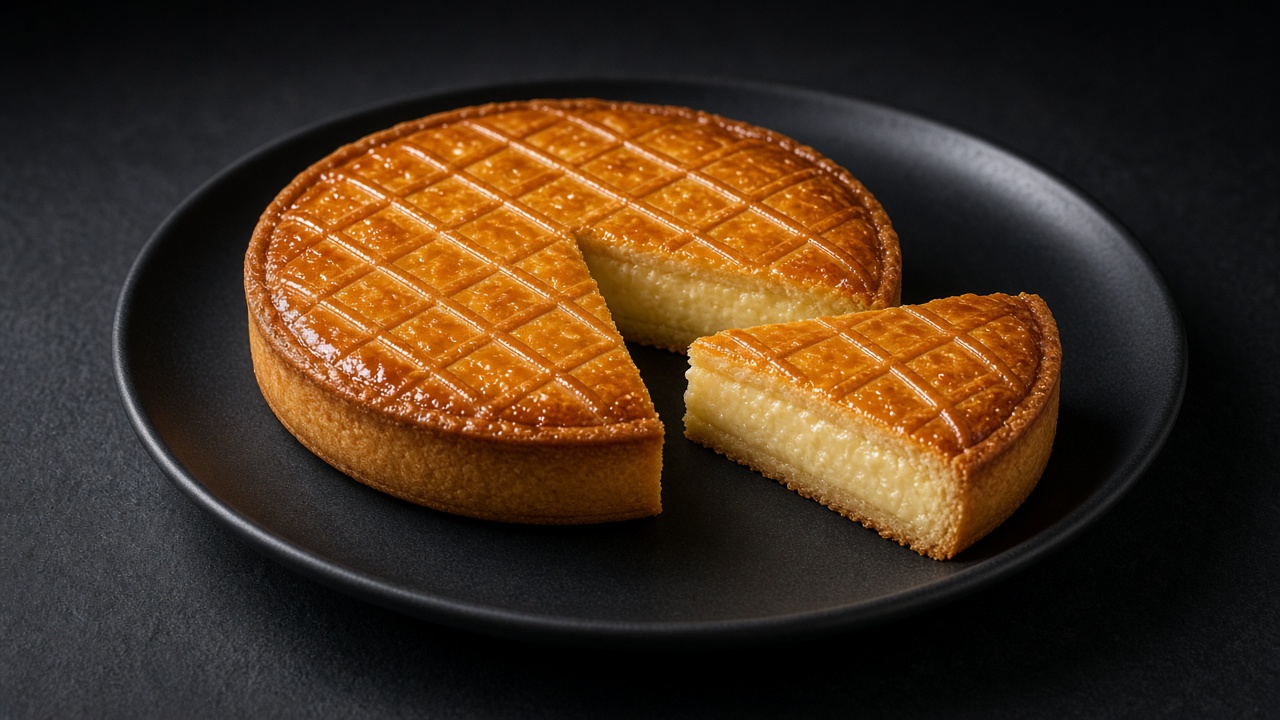
Gâteau Basque (Almond Pastry Cake with Custard)
Inspired by techniques from Serious Eats and NYT Cooking.
A rustic almond pastry cake from the Basque region, filled with a thick vanilla custard and finished with a scored, golden crust.
Always check the labels of the products you use.
Method
- 1
Make the pastry cream. Heat the milk in a saucepan until steaming. Whisk the egg yolks, sugar and cornflour together, pour in the hot milk while whisking, then return everything to the pan and whisk constantly over medium heat until it thickens and comes to the boil; keep it bubbling for 1 minute. Off the heat, stir in the vanilla and cold butter, then press cling film onto the surface and chill for at least 3 hours. The cornflour lets the custard hold its shape firmly once baked inside the pastry, rather than running out when sliced.
- 2
Make the pastry dough. Beat the butter, sugar and salt together for 2 minutes until just creamy rather than light and fluffy, then beat in the egg, yolks, lemon zest and vanilla. Mix in the flour, ground almonds and baking powder on low speed until it just comes together into a soft dough. Keeping the butter only lightly creamed gives the baked pastry its characteristic short, biscuit-like texture rather than a cakey one.
- 3
Chill the dough. Divide the dough roughly 60:40, shape each piece into a disc, wrap and chill for 2 hours. The dough is very soft at this stage, so it needs this time in the fridge before it can be rolled without sticking or tearing.
- 4
Line the tin. Heat the oven to 175°C (155°C fan) for at least 20 minutes, with a shelf in the lower-middle position. Roll the larger disc between sheets of baking paper to about 30 cm and use it to line the buttered tin, pressing it up the sides; roll the smaller disc to about 24 cm for the lid. Chill both pieces for 15 minutes so the pastry firms back up and holds its shape as the cake is assembled.
- 5
Fill and seal. Whisk the chilled pastry cream until smooth, then spread it into the pastry case, stopping about 1 cm short of the top edge. Lay the pastry lid over the top, press the edges firmly together to seal in the custard, and trim off any excess overhang.
- 6
Finish, bake and cool. Brush the top with egg wash, chill for 10 minutes, then brush again and score a crosshatch pattern into the surface with a fork. Bake for 45-55 minutes until deeply golden all over. Leave the cake to cool completely in the tin, since the custard filling needs this time to firm up before it can be unmoulded cleanly. Serve at room temperature, keeping any leftovers in the fridge.
Storage
Once cooled, keep the cake covered in the fridge and eat within 3 days. Serve it at room temperature rather than reheating, since the custard filling is already fully cooked.
Equipment
- medium saucepan
- balloon whisk
- cling film
- stand mixer or electric hand whisk
- 23 cm loose-based cake tin or tart ring (4-5 cm deep), buttered
- rolling pin
- baking paper
- fork
Nutrition per serving (estimated values)
| Per serving | Amount |
|---|---|
| Energy | 508 kcal |
| Protein | 9 g |
| Carbohydrate | 56.8 g |
| of which sugars | 30.3 g |
| of which free sugars | 27.1 g |
| Fat | 27.7 g |
| of which saturates | 13.9 g |
| Fibre | 1.6 g |
| Salt | 0.5 g |
Protein per 100 kcal
1.8 g High Protein needs ≥ 10 g
Calculated from USDA FoodData Central ingredient values