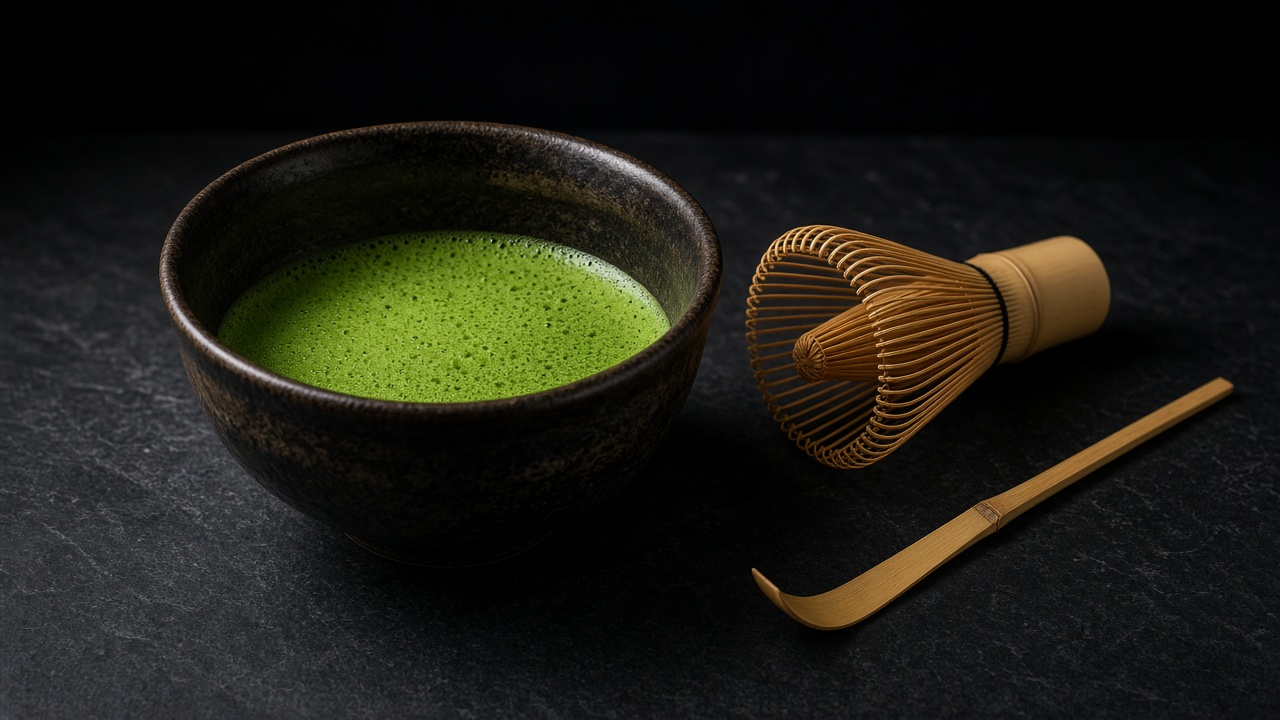
Frothy Whisked Matcha Green Tea
Inspired by techniques from America's Test Kitchen and NYT Cooking.
Sifted matcha is whisked to a paste with a little 80 °C water, then whisked briskly with the rest until covered in fine green foam.
None of the 14 major EU allergens. Always check the labels of the products you use.
Method
- 1
Warm the bowls. Pour some hot water into each bowl to warm it, then pour it away and dry the whisk. Let the 140 ml water cool to 80 °C; boiling water makes matcha bitter.
- 2
Sift. Sift 2 g matcha into each bowl to break up any lumps.
- 3
Make a paste. Add 15 ml of the water to each bowl and whisk gently into a smooth paste with no dry spots.
- 4
Whisk to a froth. Add the remaining water, about 55 ml per bowl, and whisk briskly in a zigzag 'M' motion from the wrist for 20-30 seconds, until covered in fine, pale green foam. Lift the whisk out from the centre.
- 5
Serve. Drink straight away, before the powder settles. For a milder, longer drink, stir in up to 120 ml more 80 °C water after whisking.
Storage
Best made and drunk at once; it doesn't keep. Cool leftovers in a shallow container and refrigerate within 2 hours (within 1 hour on a day above 32°C).
Why it's healthy
0.6 g protein for 6 kcal = 10 g per 100 kcal. Our High Protein label needs at least 10 g per 100 kcal. How we decide
- Total fat: 15 % of energy (limit ≤ 30%)
- Saturated fat: 0 % of energy (limit < 10%)
- Free sugars: 0 % of energy (limit < 10%)
- Salt: 0 g (limit ≤ 0.02 g)
- Fibre or fruit & veg: 0.8 g fibre / 0 g veg (limit ≥ 0.1 g fibre or 80 g fruit & veg)
Per serving, worked out from the nutrition table against our WHO-based rule. Not endorsed by WHO.
Equipment
- kettle and thermometer
- fine tea strainer or small sieve
- 2 wide tea bowls (or cereal bowls)
- bamboo matcha whisk (chasen) or small milk frother
Nutrition per serving (estimated values)
| Per serving | Amount |
|---|---|
| Energy | 6 kcal |
| Protein | 0.6 g |
| Carbohydrate | 0.8 g |
| of which sugars | 0 g |
| of which free sugars | 0 g |
| Fat | 0.1 g |
| of which saturates | 0 g |
| Fibre | 0.8 g |
| Salt | 0 g |
Protein per 100 kcal
10 g meets the High Protein rule (≥ 10 g)
Calculated from USDA FoodData Central ingredient values