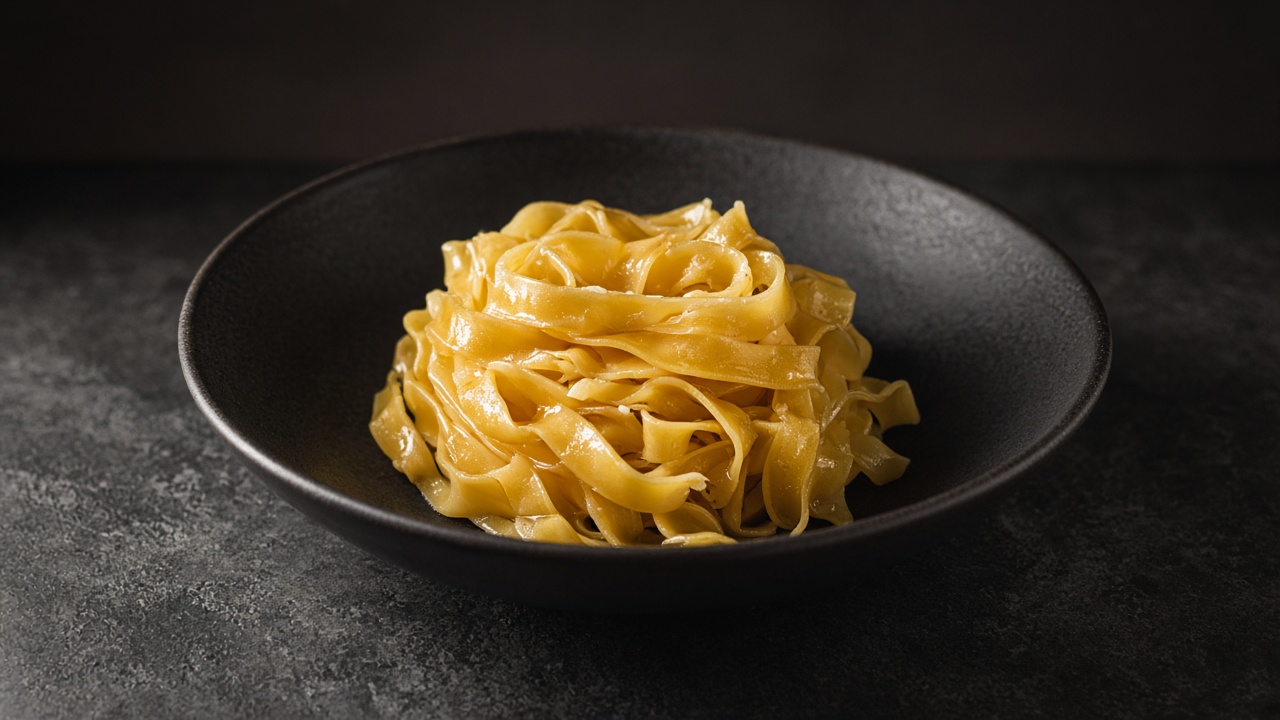
Fresh Egg Tagliatelle with Butter and Parmesan
Inspired by techniques from Serious Eats and NYT Cooking.
A rich, egg-heavy pasta dough rolled thin and tossed simply with butter, Parmesan and black pepper, letting the fresh pasta itself be the star.
Always check the labels of the products you use.
Method
- 1
Mix the dough. Tip the flour onto the worktop and shape it into a mound with a 12cm well in the centre, then crack in the eggs, yolks and salt. Beat the eggs with a fork, gradually drawing in flour from the inner wall of the well until a soft paste forms, then use a bench scraper to fold in the rest. This slow build keeps the mixture from turning into a wet, unworkable mess.
- 2
Knead until smooth. Knead the dough for 8-10 minutes, pushing with the heel of your hand and folding it back on itself, until it feels smooth, firm and springs back slowly when poked. This develops the gluten network that gives the pasta its structure, and the egg — at roughly 67% of the flour's weight — keeps the dough firm rather than sticky. Wet your hands slightly if it cracks, or dust in a teaspoon of flour at a time if it's tacky.
- 3
Rest the dough. Wrap the dough and leave it to rest for 30-60 minutes at room temperature. This gives the gluten time to relax and the flour time to fully hydrate, so the dough rolls out smoothly later instead of springing back and shrinking.
- 4
Roll into sheets. Cut the dough into 4 pieces, keeping the ones you're not using covered so they don't dry out. Flatten one piece and pass it through the widest setting of the pasta machine, fold it into thirds and pass it through twice more, then run it through the narrower settings once each until you reach the second-thinnest setting, about 1mm thick — you should just be able to see your hand through it.
- 5
Rest the sheets. Lay the rolled sheets out and dust them lightly with flour, then leave for 5-10 minutes until the surface feels leathery rather than wet or brittle. A slightly dried surface stops the strands sticking to each other once cut.
- 6
Cut the ribbons. Roll each sheet up loosely and slice across into 7-8mm wide ribbons, then unroll and shake them out into loose nests on trays dusted with semolina. Handle them gently so the ribbons keep their shape rather than tangling.
- 7
Cook briefly. Bring 4 litres of water to the boil with the 32g of salt, and set the butter in a warm serving bowl ready to melt. Cook the tagliatelle for just 2-3 minutes, stirring, until tender with a slight bite, since fresh pasta cooks far faster than dried. Reserve 240ml of the cooking water before lifting the pasta out with tongs.
- 8
Toss with butter and cheese. Transfer the pasta into the warm bowl with 80ml of the reserved water and half the Parmesan, then toss vigorously for 30-60 seconds until the butter melts into a creamy coating. The vigorous tossing emulsifies the fat and starchy water together rather than letting them separate. Loosen with a little more water if needed, then finish with black pepper and the remaining Parmesan.
Storage
Fresh, uncooked tagliatelle keeps in the fridge for up to 1 day on a floured tray, or freeze the nests for up to 1 month and cook from frozen with an extra minute. Reheat any cooked leftovers gently with a splash of water until piping hot. Cool leftovers in a shallow container and refrigerate within 2 hours (within 1 hour on a day above 32°C).
Equipment
- clean worktop or large board
- fork
- bench scraper
- cling film
- pasta machine (or long rolling pin)
- sharp knife
- 2 baking trays
- large pot (at least 5 litres)
- tongs
- warm serving bowl
Nutrition per serving (estimated values)
| Per serving | Amount |
|---|---|
| Energy | 539 kcal |
| Protein | 19.5 g |
| Carbohydrate | 61.4 g |
| of which sugars | 0.5 g |
| of which free sugars | 0 g |
| Fat | 23.1 g |
| of which saturates | 12.3 g |
| Fibre | 2.2 g |
| Salt | 1.55 g |
Protein per 100 kcal
3.6 g High Protein needs ≥ 10 g
Calculated from USDA FoodData Central ingredient values