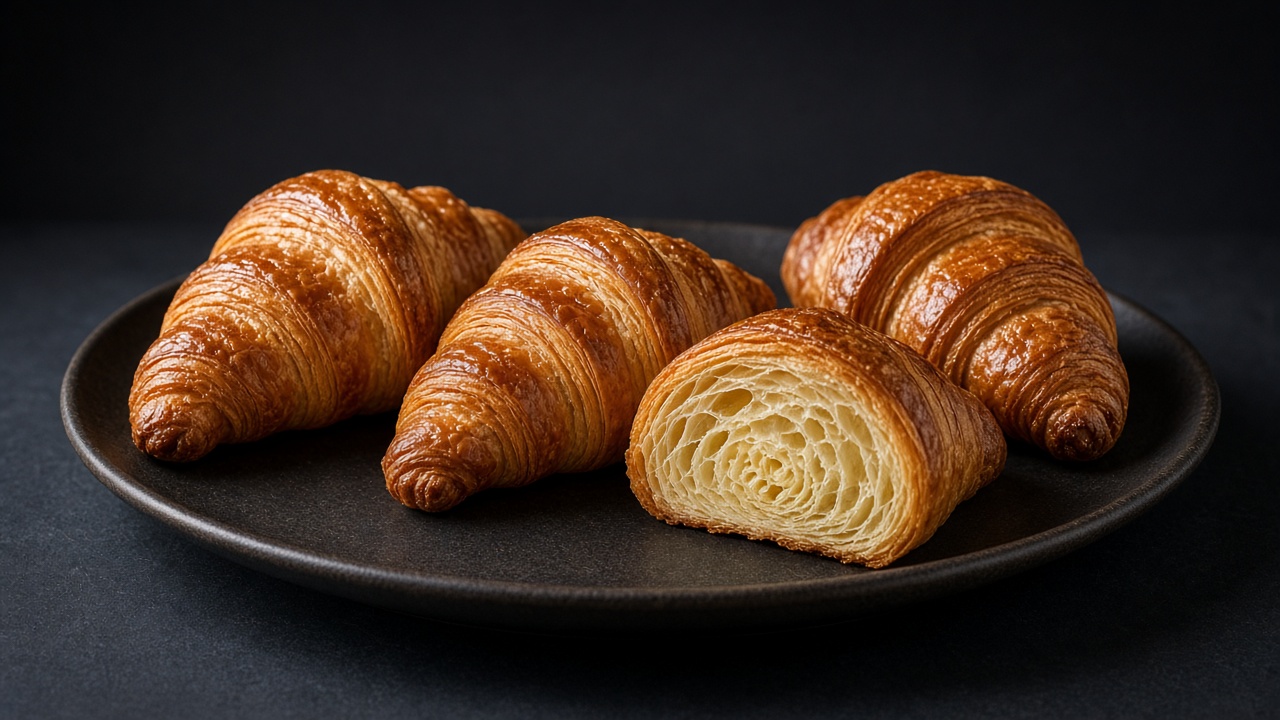
Flaky Butter Croissants
Crisp, deeply golden croissants with hundreds of buttery layers, made from scratch with a classic three-fold lamination.
Always check the labels of the products you use.
Method
- 1
Make the dough. Mix the flour, sugar, salt and yeast, then add the milk, water and softened butter and knead for 4-5 minutes to a smooth, fairly firm dough. Pat it into a 2cm-thick rectangle, wrap and chill overnight for 8-12 hours. This long, cold rest relaxes the gluten and brings the dough to the same firmness as the butter block, which matters for even layers later.
- 2
Prepare the butter block. Between two sheets of baking paper, beat the cold butter with the rolling pin into a 17 x 17cm square, then chill for 30 minutes until firm but still pliable. The butter needs to bend without cracking or melting - too soft and it squeezes out, too hard and it shatters into the dough instead of forming clean sheets.
- 3
Lock in the butter. With the dough rolled out to 34 x 17cm, lay the butter block over one half, then fold the other half over and seal the edges firmly. This encases the butter completely, so the next rolls create neat, separate layers rather than a mixed-up paste.
- 4
Laminate with three folds. Roll the dough out to 60 x 20cm, fold it into thirds like a letter, then wrap and chill for 30-45 minutes. Repeat this rolling and folding twice more for three single folds in total, chilling between each one, and give the dough extra time in the fridge if the butter starts showing through or smearing. Finish with a 1-hour chill after the last fold so everything is firm and easy to shape.
- 5
Shape the croissants. Roll the laminated dough into a 50 x 25cm rectangle about 4mm thick, trim the edges neatly, then cut 12 tall triangles with 9cm bases. Notch the centre of each base by 1cm, stretch the triangle gently and roll it up from base to tip, setting each one tip-down and well spaced on the lined trays.
- 6
Prove until doubled. In a warm spot at 24-26°C - no hotter, or the butter layers will melt - the shaped croissants need 2-3 hours to prove, loosely covered. They're ready when doubled in size, wobbly to the touch and the layers are visible along the sides.
- 7
Bake to deep gold. At 200°C (180°C fan), brush the croissants gently with egg wash and bake for 18-22 minutes. Look for a deep golden-brown colour all over and a hollow sound when you tap the base; the centre should read about 90°C, by which point the layers have fully set and crisped.
- 8
Cool before eating. A short 15-minute rest on the wire rack lets the inside finish setting before the croissants are eaten. They're best enjoyed the same day, while the layers are at their crispest.
Storage
Croissants are best eaten the day they're baked. Keep any leftovers airtight for up to 1 day and refresh in a 180°C oven for 5 minutes, or freeze baked croissants for up to 1 month and reheat from frozen until piping hot. Cool leftovers in a shallow container and refrigerate within 2 hours (within 1 hour on a day above 32°C).
Equipment
- stand mixer with dough hook (or large bowl)
- rolling pin
- ruler
- baking paper
- cling film
- sharp knife or pizza wheel
- 2 baking trays lined with baking paper
- pastry brush
- wire rack
Nutrition per serving (estimated values)
| Per serving | Amount |
|---|---|
| Energy | 376 kcal |
| Protein | 5.7 g |
| Carbohydrate | 37.2 g |
| of which sugars | 5.3 g |
| of which free sugars | 4.6 g |
| Fat | 22.9 g |
| of which saturates | 14.1 g |
| Fibre | 1.3 g |
| Salt | 1.01 g |
Protein per 100 kcal
1.5 g High Protein needs ≥ 10 g
Calculated from USDA FoodData Central ingredient values