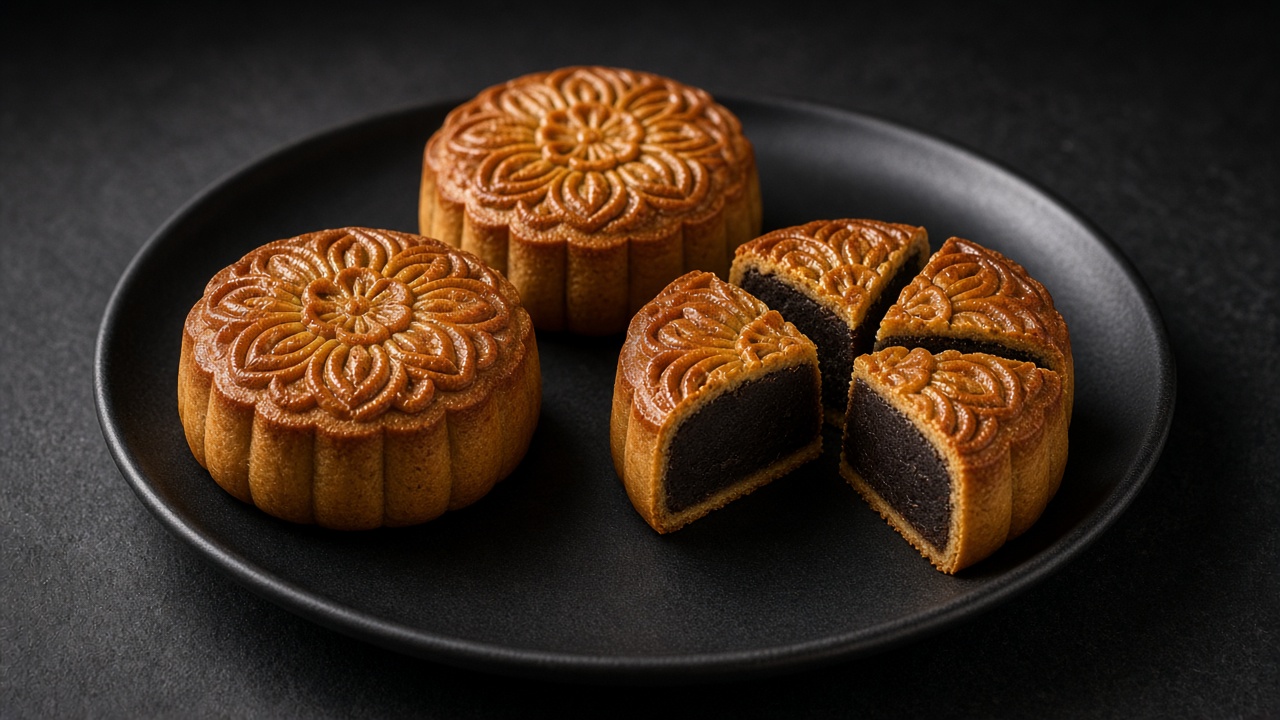
Baked Mooncakes with Lotus Seed Paste
Inspired by techniques from King Arthur Baking.
Patterned golden mooncakes with a tender, honey-enriched crust wrapped around a smooth sweet lotus seed filling.
Always check the labels of the products you use.
Method
- 1
Alkaline. Simmer 240 ml water with ½ tsp bicarbonate of soda for 7-8 min until reduced to about 2 tbsp, then cool and keep only ½ tsp of it.
- 2
Dough. Beat 147 g honey, the ½ tsp alkaline water, 66 g oil, 240 g cake flour and ½ tsp salt until smooth, then wrap and chill 30 min along with the 340 g lotus seed paste.
- 3
Divide. Divide the dough into 6 balls of about 79 g and the paste into 6 balls of about 57 g.
- 4
Wrap. On oiled cling film, roll each dough ball into a 6 mm thick, 12 cm round, set a paste ball in the centre, wrap and press shut, then roll smooth.
- 5
Press. Press each ball into a floured mould onto a lined tray to print the pattern, spacing them 5 cm apart, then freeze 5-10 min.
- 6
Glaze. Heat the oven to 190 °C, whisk 1 egg, 1 egg yolk, 1½ tsp milk and a pinch of salt, and brush two coats over the cakes.
- 7
Bake. Bake 15-20 min until firm with golden bases, then cool completely on the tray before cutting into quarters.
Storage
Keeps 1-2 days in an airtight container, 1 week chilled, or 3 months frozen.
Equipment
- small saucepan
- stand mixer with flat beater
- cling film
- rolling pin
- 100-150 g mooncake press
- baking tray lined with baking paper
- pastry brush
Nutrition per serving (estimated values)
| Per serving | Amount |
|---|---|
| Energy | 514 kcal |
| Protein | 7.9 g |
| Carbohydrate | 85.8 g |
| of which sugars | 43 g |
| of which free sugars | 42.8 g |
| Fat | 16.3 g |
| of which saturates | 1.9 g |
| Fibre | 2.5 g |
| Salt | 0.69 g |
Protein per 100 kcal
1.5 g High Protein needs ≥ 10 g
Calculated from USDA FoodData Central ingredient values